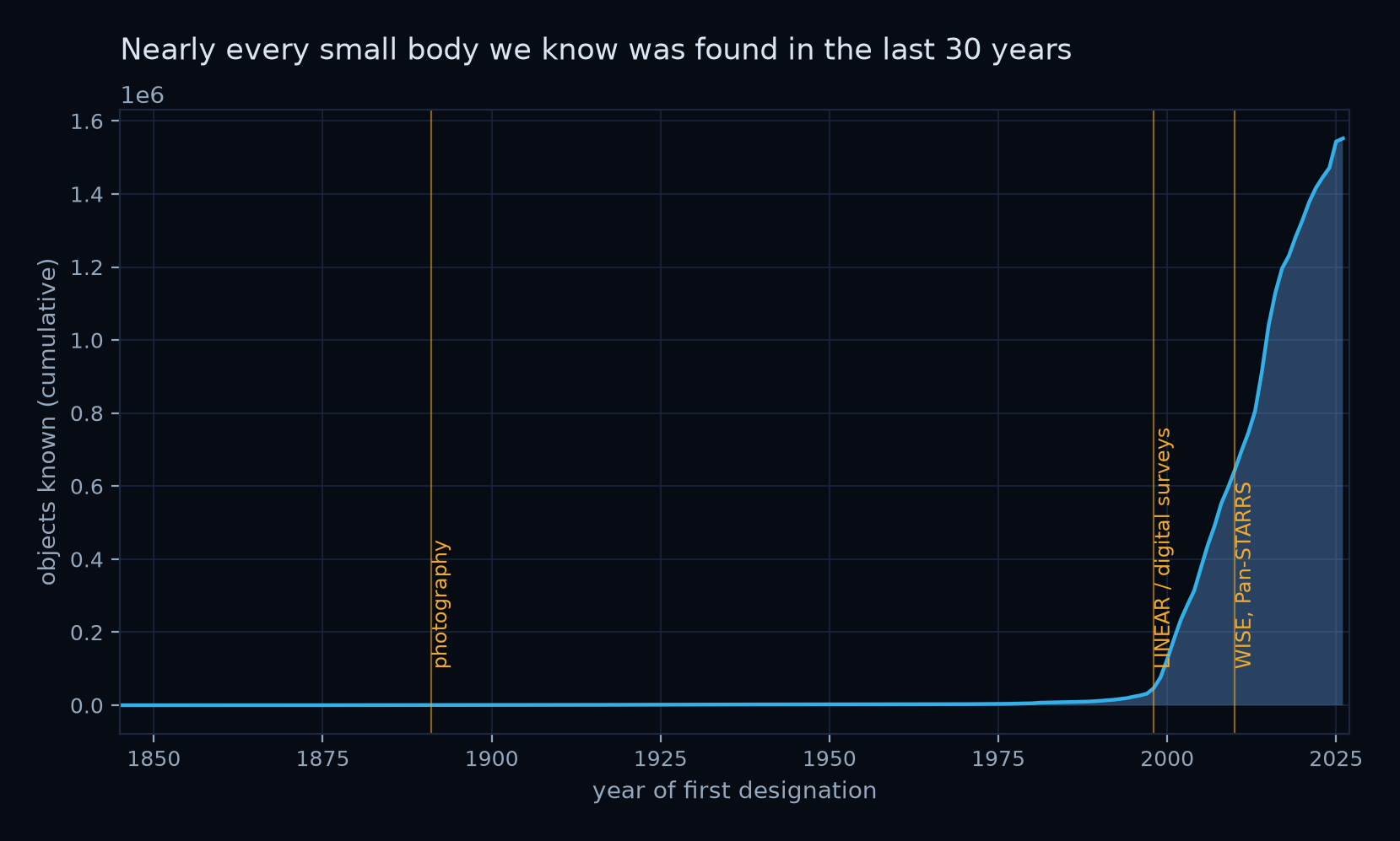
A gap where a planet should be
Johann Titius noticed that the planets' distances from the Sun follow a rough numerical pattern, popularised by Johann Bode. The pattern predicted a planet between Mars and Jupiter, and there wasn't one. The gap bothered astronomers enough that a group of them — the self-styled "Celestial Police" — organised a systematic search.
The Titius–Bode law has no accepted physical basis and is now generally regarded as numerology. It was still useful: it told people where to look.
Ceres, found by accident on New Year's Day
Giuseppe Piazzi, working in Palermo on a star catalogue, recorded a faint object that moved between nights. He tracked it for six weeks before illness and its approach to the Sun ended the observations. Then it was lost.
Recovering it required knowing its orbit, and there was not enough data to compute one by existing methods. The 24-year-old Carl Friedrich Gauss invented what was needed — the method of least squares, and a technique for determining an orbit from three observations — and predicted where to look. Ceres was found again almost exactly where he said. Modern orbit determination begins here, and every position in the catalog is a descendant of that calculation.
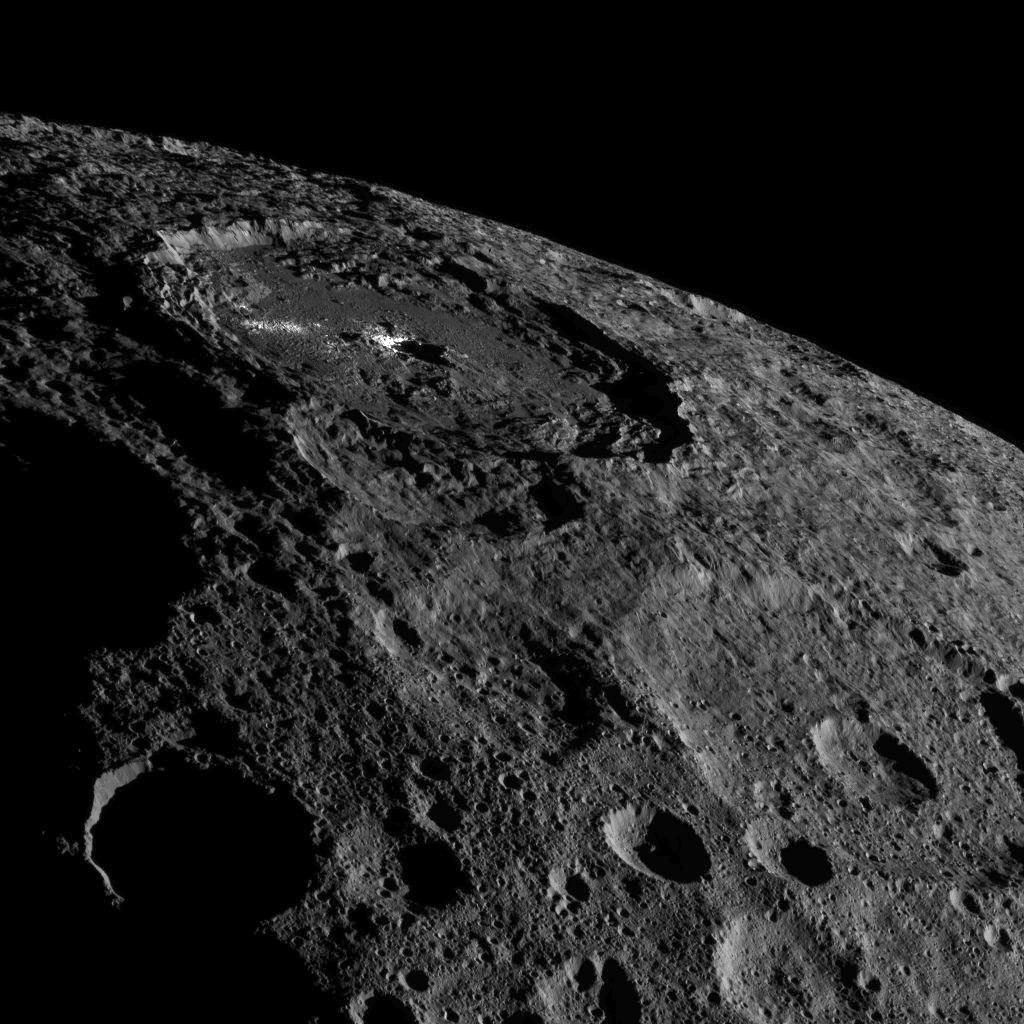
Not one planet but several
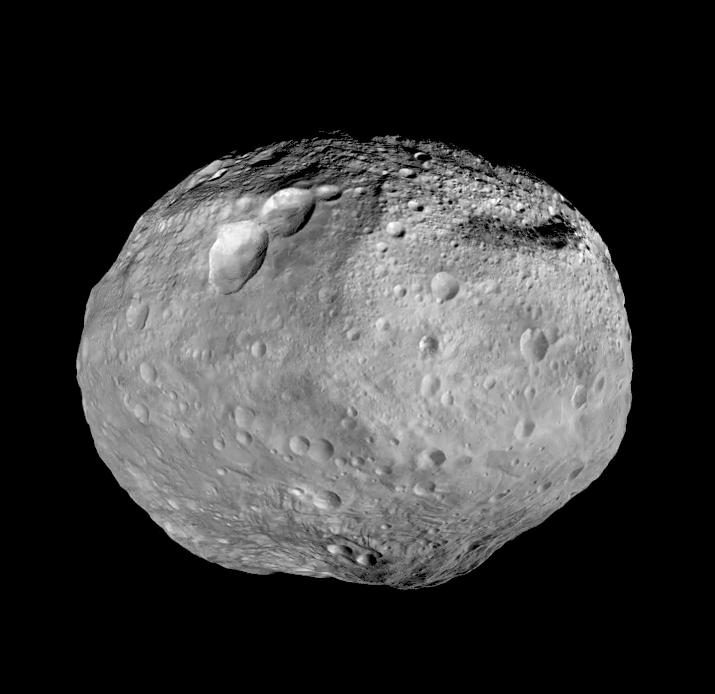
Pallas followed in 1802, Juno in 1804, Vesta in 1807. A single planet in the gap could be accommodated; four small bodies sharing the same region could not. William Herschel proposed calling them asteroids — "star-like" — because unlike planets they showed no disk.
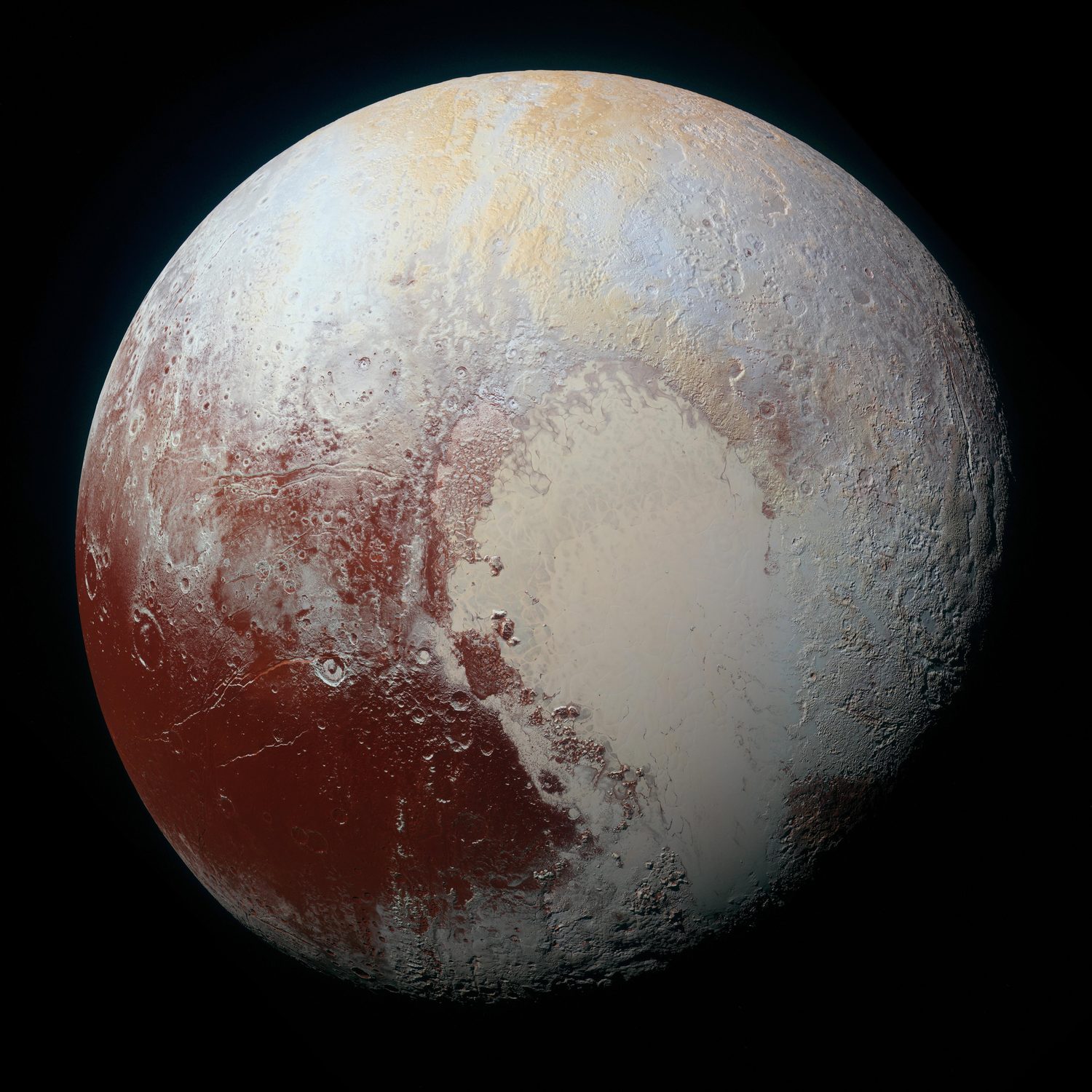
The naming stuck, and so did the demotion. It is worth noticing that this argument — is a small round thing in a crowded orbit a planet? — is exactly the argument that would be had about Pluto two centuries later.
Kirkwood reads the gaps
Daniel Kirkwood, with fewer than a hundred known asteroids, noticed that their orbital distances were not evenly distributed: there were gaps, and the gaps fell where an asteroid's orbital period would be a simple fraction of Jupiter's.
It was the first demonstration that the belt has structure imposed on it by the planets, rather than being random debris. Our own version of his histogram, drawn from 1.46 million asteroids instead of a hundred, is on the main-belt page — the gaps land exactly where the resonance arithmetic says they should.
Photography changes the arithmetic
Max Wolf began photographing the sky with long exposures. On a plate tracking the stars, an asteroid draws a short trail instead of a point — it identifies itself. Wolf found more than 200 asteroids this way.
Before photography, discovery meant an observer noticing a moving point among thousands of stars, by eye, and remembering the field. After it, discovery became a matter of collecting plates and being systematic. The discovery rate changed by an order of magnitude, and this is the first of two times it happens for the same reason: a change in detector.
Pluto, from a farm boy and a blink comparator
Clyde Tombaugh, hired at Lowell Observatory on the strength of homemade telescopes, found Pluto at 24 by photographing the same field days apart and flicking between the plates in a blink comparator, watching for the one dot that shifted.
It is the most famous discovery in this history, it happened at the observatory this project observes from, and it is a better story than the textbook version. It has its own page →
The near-Earth objects arrive
Apollo was found in 1932, on an orbit that crossed Earth's. Hermes passed within twice the Moon's distance in 1937 and was then lost for 66 years. Icarus, in 1949, came inside Mercury's orbit at perihelion.
These objects turned asteroids from a curiosity of celestial mechanics into something with consequences. The recognition that they occasionally hit things — and that the geological record shows as much — took several decades longer to become respectable.
Seeing one up close, and finding a moon
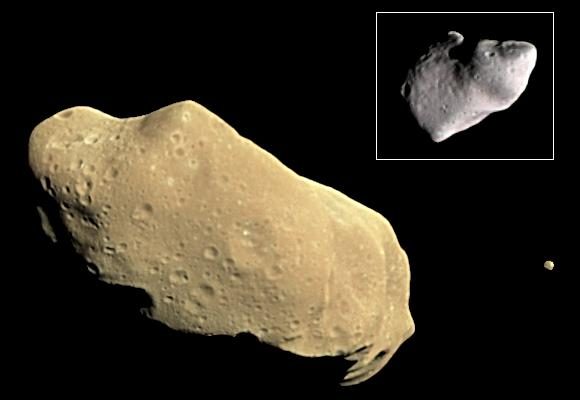
Galileo, en route to Jupiter, flew past 951 Gaspra in 1991 — the first close look at an asteroid, and the first proof that they are irregular, cratered, and individual rather than interchangeable.
Two years later it passed 243 Ida and found something nobody expected: a moon. Dactyl is about 1.4 km across and orbits a body roughly 60 km end to end. Asteroid satellites are now known to be common, and each one is a free measurement of its primary's mass.
A second belt, beyond Neptune
David Jewitt and Jane Luu found 1992 QB1, an object beyond Neptune on a nearly circular orbit. It was the first confirmation of a population that Kenneth Edgeworth and Gerard Kuiper had argued for decades earlier: the solar system does not end at the outermost planet.
The catalog now holds 6,387 trans-Neptunian objects, and their orbital structure turns out to be a record of Neptune's migration. Pluto's status was quietly settled the moment this population was found — it had company.
Automation, and the third detector revolution
CCD detectors plus telescopes that survey the same sky repeatedly plus software that finds moving objects without a human blinking between plates: LINEAR, NEAT, Spacewatch, the Catalina Sky Survey and Pan-STARRS between them changed the discovery rate by another order of magnitude.
In 2010 the WISE spacecraft added thermal infrared, which measures an asteroid's size rather than just its brightness — the reason the roughly 140,000 diameters in the catalog exist at all.
Visiting them, and catching visitors
Dawn orbited Vesta and then Ceres. New Horizons flew past Pluto and then a small Kuiper Belt object. Hayabusa2 and OSIRIS-REx brought material back from Ryugu and Bennu. DART deliberately changed an asteroid's orbit, demonstrating that deflection is an engineering problem rather than a hypothetical one.
And three objects arrived from outside the solar system entirely: 1I/'Oumuamua in 2017, 2I/Borisov in 2019, and 3I/ATLAS in 2025. The sample size for interstellar material went from zero to three within a decade, because the surveys finally got good enough to notice.

Where that leaves us
Piazzi found one object in 1801 and nearly lost it again. The current release holds 1,557,369, and the limiting factor is no longer finding them. It is that we know almost nothing about most of them: a diameter for 8.97%, a rotation period for 2.22%, a surface composition for 0.14%.
The next chapter of this history is probably not another detector revolution. It is the slower work of characterising what the surveys have already found — and a good deal of that work is within reach of a small telescope and some patience, which is where this project comes in.
Comets have their own version of this story, and the catalog records it by name — see who finds the comets on the comet family page, counted from the designations themselves.