Gaps, spikes, and a belt that is really a torus
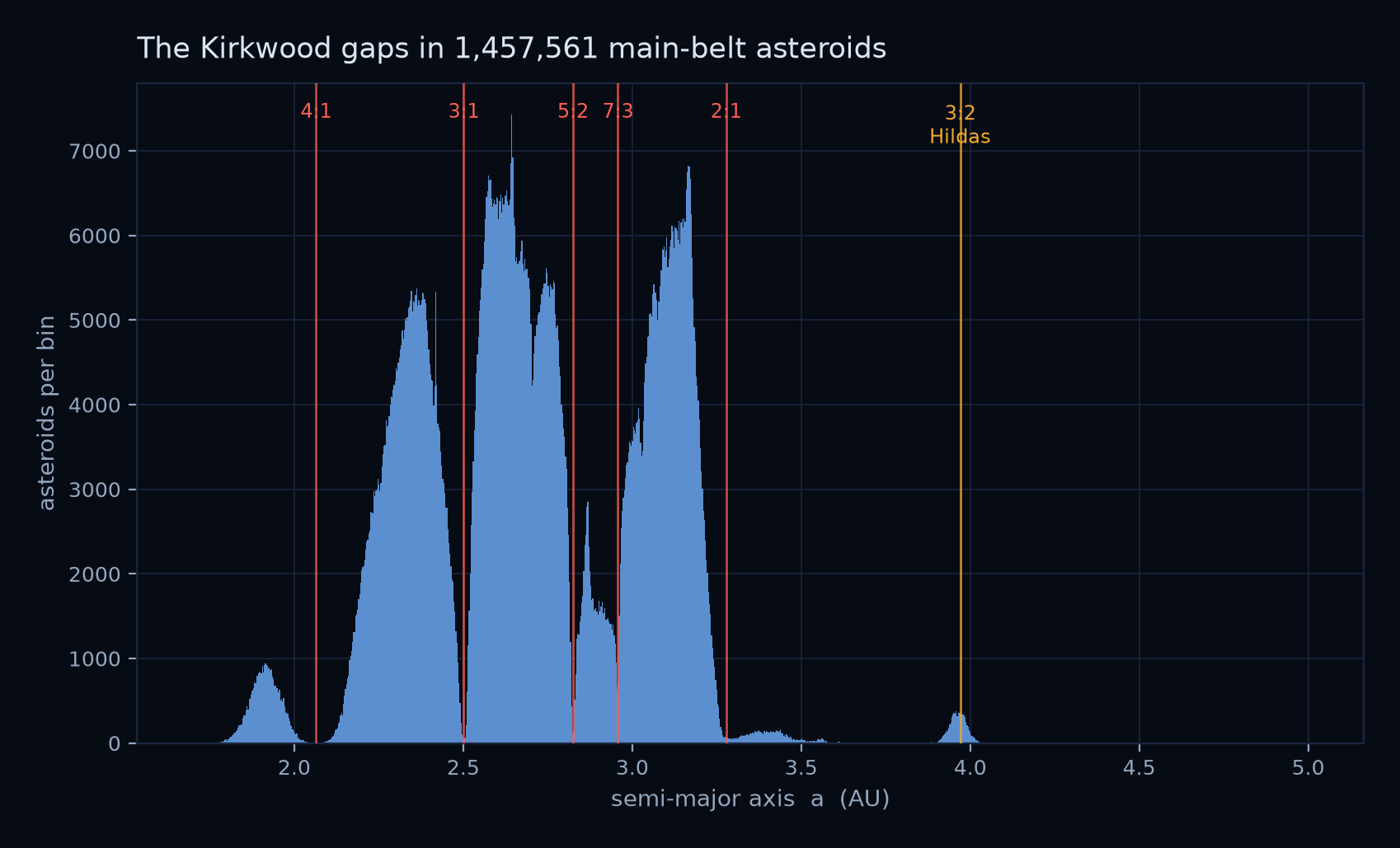
An asteroid at 2.50 AU completes exactly three orbits for every one of Jupiter's, which means it meets Jupiter at the same point every time, so the same small tug repeats and accumulates instead of averaging away until the orbit is pumped over millions of years and the asteroid is thrown onto a planet-crossing path. The result is a set of empty lanes at precise, predictable distances — the 3:1, 5:2, 7:3 and 2:1 resonances — discovered by Daniel Kirkwood in 1866, when fewer than a hundred asteroids were known; the figure above reproduces his result from 1.46 million. Not every resonance empties, though. The 3:2 at 3.97 AU is protective: the Hildas trapped there are shepherded into stable orbits instead of ejected, and they show up as a spike exactly where the gaps show dips.
Illustrations also flatten the belt into a ring, and it is really a torus roughly an AU from top to bottom, because orbital inclinations are spread over tens of degrees — a typical belt asteroid swings about half an AU above and below the plane of the planets. The side-on view in our 3-D viewer shows this directly: a bright dense midplane inside a diffuse high-inclination halo.
Families: the debris of specific collisions
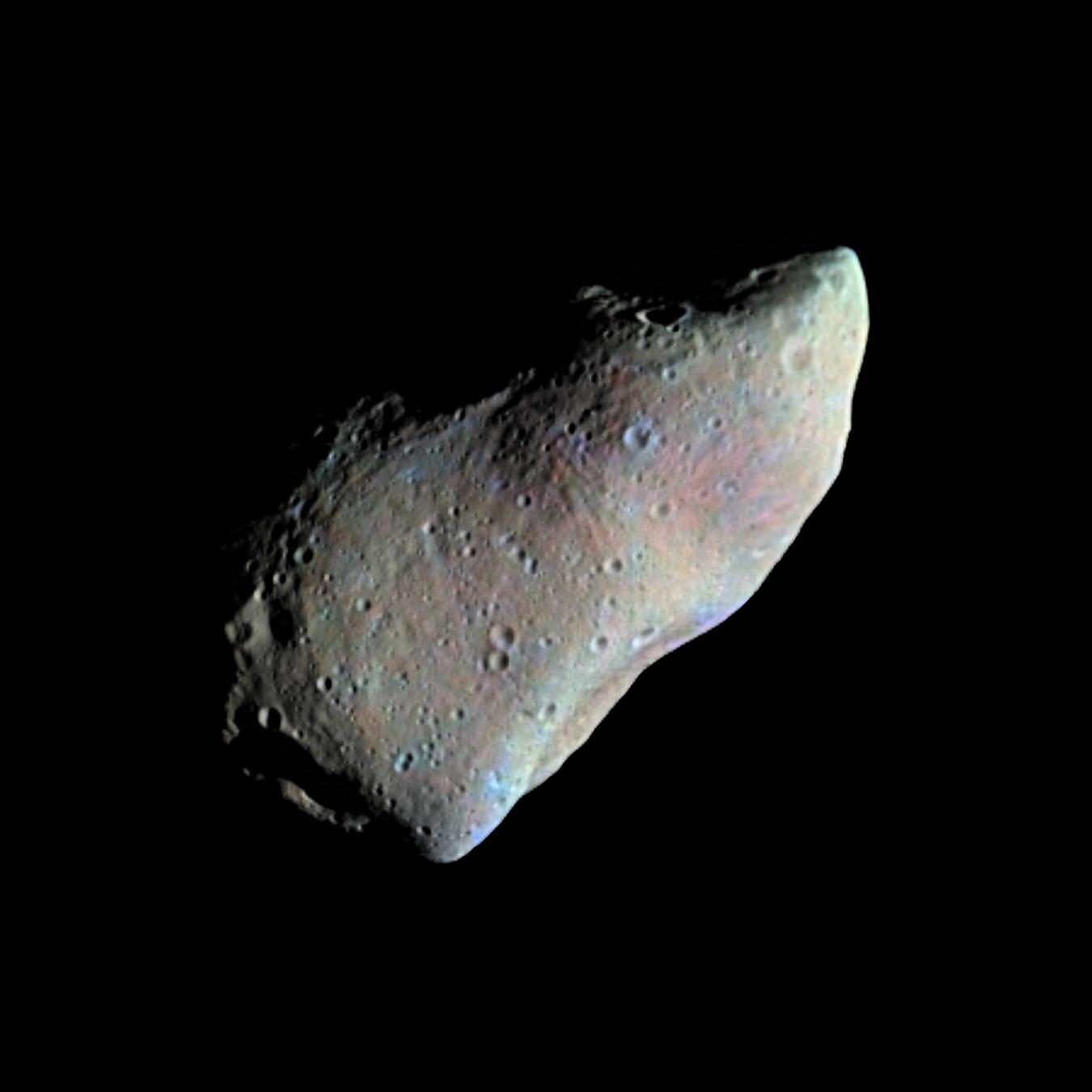
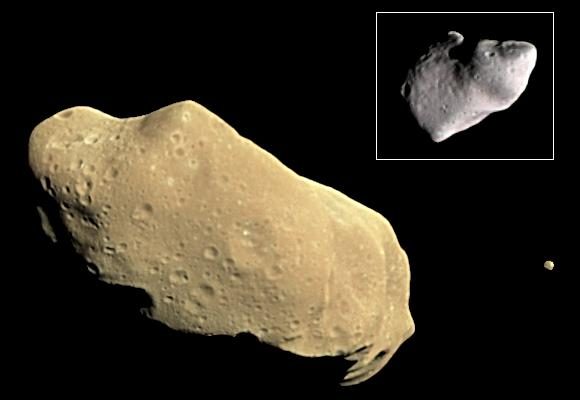
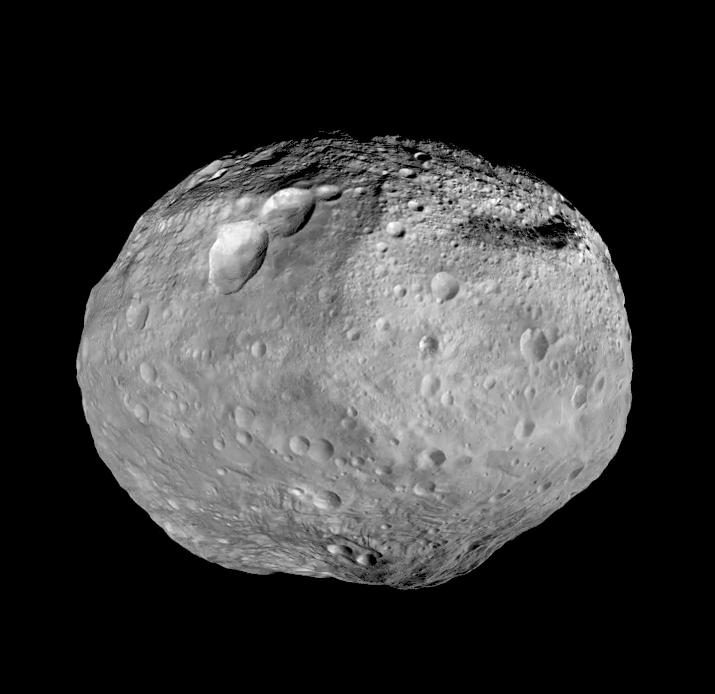
Cluster the belt tightly enough in orbital elements and it breaks into families — groups sharing an origin in the catastrophic disruption of one parent body, still travelling together millions of years later. Members of a family tend to share a composition, which makes them natural laboratories for asking what the inside of an asteroid looks like.
Identifying families properly needs proper orbital elements, averaged over the short-term wobbles that osculating elements contain. The database carries osculating elements today; the schema is keyed so proper elements can be added as an additional element set rather than a migration.
The spin barrier
Plot rotation period against size and a wall appears at about 2.2 hours. Above roughly 200 m in diameter, almost nothing spins faster. That is the point where centrifugal acceleration at the equator exceeds self-gravity: a loose pile of rubble held together by nothing but its own weight simply flies apart.
So the 1,817 objects that do spin faster are telling us something: they are either monolithic single rocks, or held together by real cohesive strength. Every one of them is a measurement someone made of a light curve.
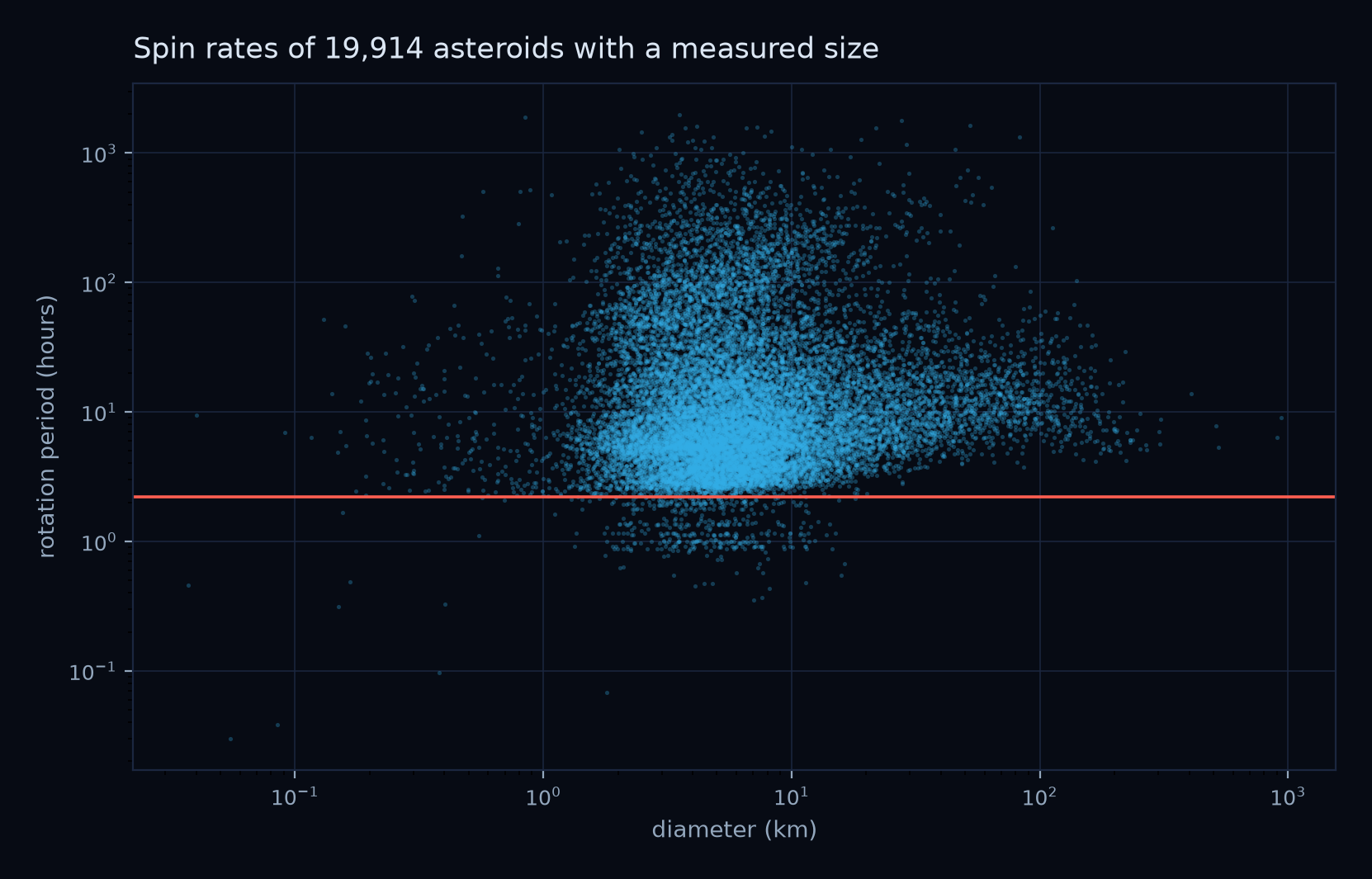
8.97% have a measured diameter and 2.22% a rotation period. For the other 1.4 million objects we know where they are and almost nothing about what they are.
Best-known members
Brightest by absolute magnitude, named objects first. Queried live from the catalog.
| Object | H | Diameter | a | e | i | Period |
|---|---|---|---|---|---|---|
| 4 Vesta (A807 FA) | 3.25 | 523 km | 2.36 AU | 0.090 | 7.1° | 3.6 yr |
| 1 Ceres (A801 AA) | 3.34 | 939 km | 2.77 AU | 0.080 | 10.6° | 4.6 yr |
| 2 Pallas (A802 FA) | 4.12 | 513 km | 2.77 AU | 0.231 | 34.9° | 4.6 yr |
| 3 Juno (A804 RA) | 5.19 | 247 km | 2.67 AU | 0.256 | 13.0° | 4.4 yr |
| 15 Eunomia (A851 OA) | 5.42 | 232 km | 2.64 AU | 0.188 | 11.8° | 4.3 yr |
| 6 Hebe (A847 NA) | 5.62 | 185 km | 2.43 AU | 0.202 | 14.7° | 3.8 yr |
| 10 Hygiea (A849 GA) | 5.65 | 407 km | 3.15 AU | 0.107 | 3.8° | 5.6 yr |
| 7 Iris (A847 PA) | 5.70 | 200 km | 2.39 AU | 0.230 | 5.5° | 3.7 yr |
The 3-D viewer plots all 1,557,369 catalogued objects at a fixed instant. Each population can be isolated, so this family can be viewed on its own against the planets.