Regular, repeatable, and not remotely sinusoidal
An asteroid is a rigid body spinning freely in a vacuum. Nothing damps it and nothing perturbs it on human timescales, so its light curve repeats with a precision closer to a clock than to a star. Point a telescope at the same asteroid a decade later and the same shape returns.
But the shape itself is not a sine wave. It is a projection of the object's actual silhouette, and that makes it far more informative than a simple oscillation. The four curves below are real, archived measurements — every point was made by a named observer and deposited in a NASA archive.
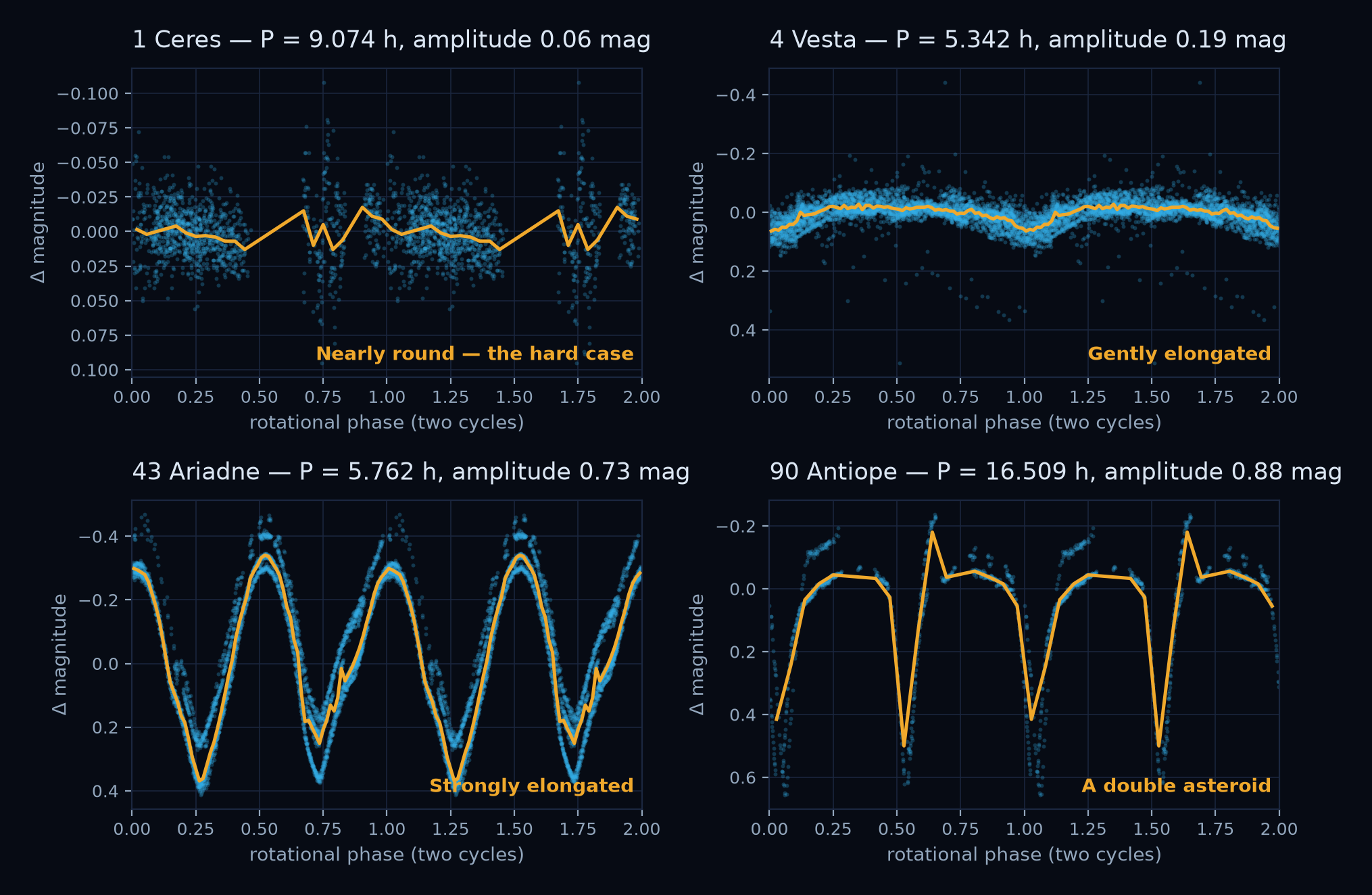
| Object | Period | Amplitude | Points | Sessions | Observers |
|---|---|---|---|---|---|
| 1 Ceres | 9.074 h | 0.06 mag | 1,210 | 5 | Robert D. Stephens |
| 4 Vesta | 5.342 h | 0.19 mag | 3,382 | 29 | V. Reddy |
| 43 Ariadne | 5.762 h | 0.73 mag | 3,404 | 9 | M. J. Dykhuis |
| 90 Antiope | 16.509 h | 0.88 mag | 676 | 4 | F. Pilcher |
Those are the observers whose nights produced the curves above. A light curve is somebody's work, and the archive records who did it.
Reading a light curve
Almost every asteroid is closer to a potato than a ball. As an elongated body turns, it shows you its broad side twice and its narrow end twice per rotation, so you get two brightness maxima and two minima per revolution — which has a practical consequence that catches people out constantly: the strongest period in your data is half the rotation period, and you fold at twice the obvious answer. If asteroids were smooth triaxial ellipsoids the two maxima would match exactly and there would be no way to tell a full rotation from a half, but they do not match. Concavities, flat facets, craters and darker patches make one maximum higher than the other and one minimum deeper, and that asymmetry is what proves you have the full period. It is visible in the Vesta and Ariadne panels above.
How large the variation gets depends on where you happen to be standing. Amplitude is set by the angle between your line of sight and the asteroid's spin axis: viewed along the pole an elongated body barely varies at all, viewed across the equator it varies maximally. So the same asteroid shows a different amplitude at each apparition, and that is not noise but signal — observe several apparitions and the pattern of amplitudes solves for the pole direction and a shape model, a multi-year project achievable from one back garden. Amplitude also grows with phase angle, because the further the Sun is off to one side the longer the shadows and the more the shape is exaggerated; the effect is a few per cent per degree, small but enough that amplitudes are only comparable when the geometry is.
Some curves are genuinely strange
Binaries. A companion produces something no shape can: discrete, sharp mutual eclipse events superimposed on the ordinary rotational variation, on a completely different period. The 90 Antiope panel above shows this — two components of nearly equal size, eclipsing each other. Amateur photometrists have discovered many binary asteroids exactly this way, by noticing dips that the rotation could not explain. Tumblers are stranger still: an object rotating about a non-principal axis does not repeat with any single period at all, because the curve is the beat of two incommensurate rhythms, so it looks chaotic. Tumbling damps out over time, so these are almost always slow rotators, and each one is a clue about internal structure and collision history.
The spin barrier. Plot period against size and a wall appears at about 2.2 hours. A loose pile of rubble held together by its own weight cannot spin faster without flying apart. So the objects that do — and the catalog holds 1,817 of them — must be either single coherent rocks or genuinely held together by cohesion. Finding another one is a real result.
The signal is large compared to the noise
This is the fact that makes small-telescope rotation work viable. Across 29,970 asteroids with a measured amplitude, the median peak-to-peak variation is 0.35 magnitudes — half of them fall between 0.21 and 0.56 mag, and 7% exceed 0.8 mag. Only 4% vary by less than 0.1 mag.
Set that against what the rig actually achieves. Photometric analysis carried out for The Variable Zoo Project puts its accuracy at roughly ±15–20 mmag on targets at 10th to 12th magnitude, degrading steadily to ±80–120 mmag by 16th.
Two caveats belong with those figures. They are estimates drawn from that variable-star work rather than a specification, and they were obtained on stars, which hold still. An asteroid drifts across the background between frames, which is harder, so treat them as an optimistic bound on what the same equipment will do on a moving target.
Even so, the comparison is favourable. A typical 0.35 magnitude amplitude is a 20:1 measurement at 11th magnitude and still 3.5:1 at 16th. Put the other way: at 11th magnitude 99% of all catalogued amplitudes are large enough to clear three times the noise, and even in the 15–16 band 57% still are. The limit is not that the signal is too small. It is that the faint end costs exposure time, and exposure time on a moving target costs trailing.
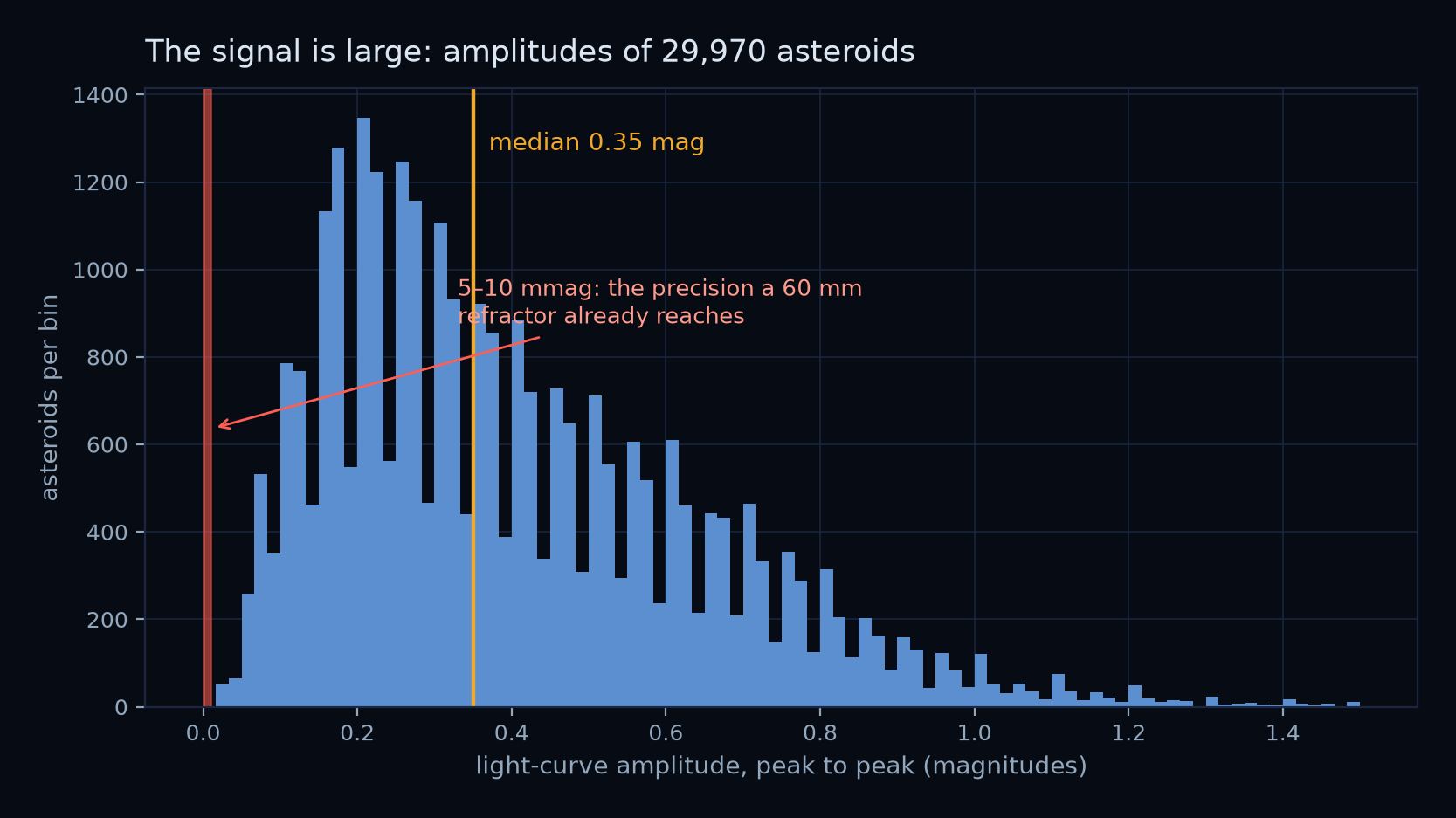
What a 60 mm refractor can actually reach
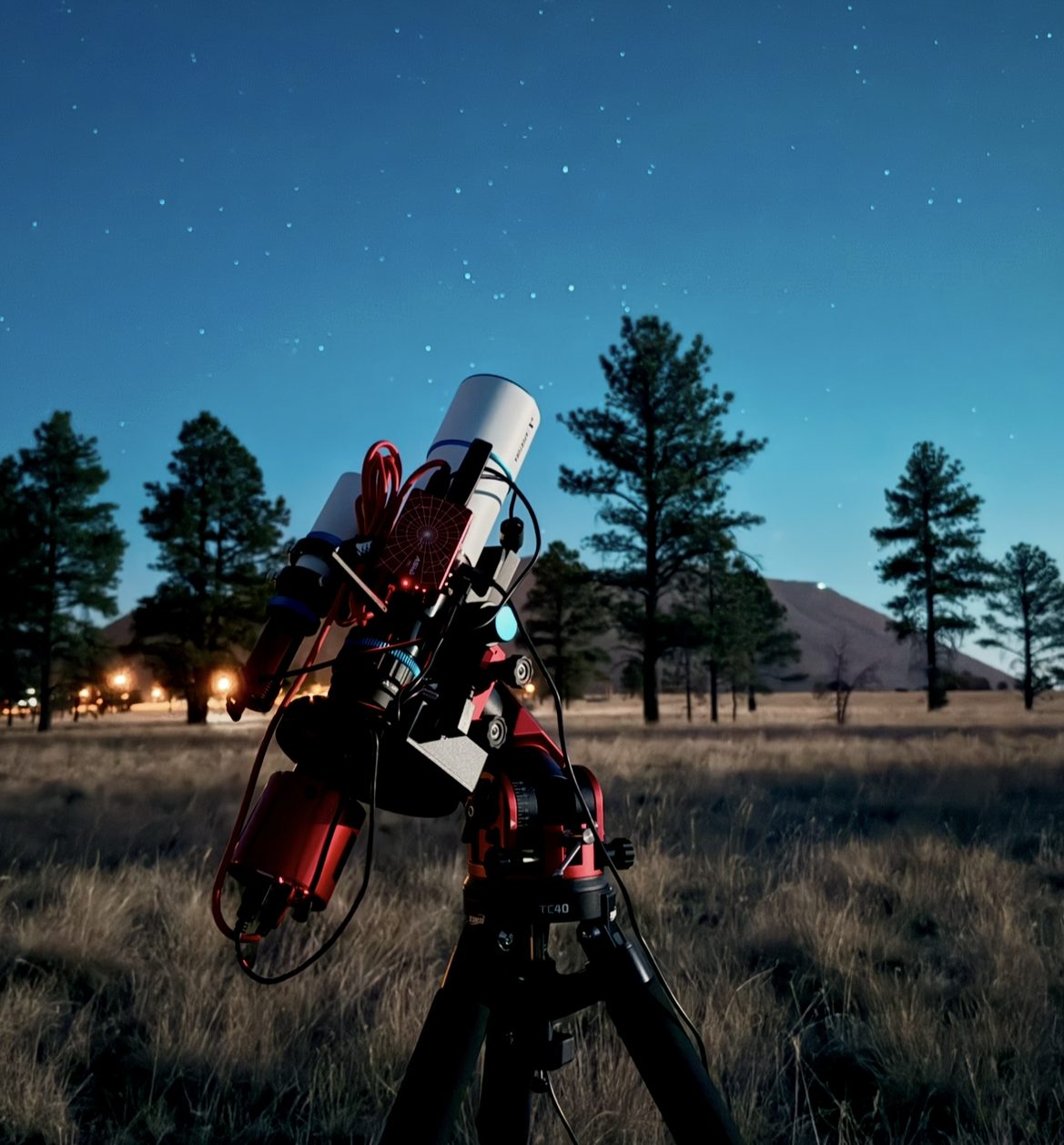
The rig this project uses is a 60 mm f/6.2 refractor with a cooled CMOS camera on a small equatorial mount — the same instrument, and the same photometry pipeline, as The Variable Zoo Project, where it has produced light curves of variable stars from 10th to 16th magnitude. The rig and the method are described there →
The geometry happens to suit moving targets very well:
- 1.29 arcsec per pixel, over a 3.0° × 2.0° field — hundreds of usable comparison stars in every frame.
- A main-belt asteroid near opposition drifts about 35 arcsec per hour. In a 30-second exposure that is 0.29 arcsec; even at 120 seconds it is 1.17 arcsec, or 0.9 pixel. No trailing.
- Over a six-hour session the target moves about 3.5 arcmin — a couple of per cent of the field width, so the same comparison stars stay in frame all night.
Brightnesses below are quoted at opposition, when an object is closest and visible all night. The measured accuracy sets the useful limit directly, without any need to extrapolate: a typical amplitude stays above three times the noise out to about 16th magnitude, and comfortably so to 14th. Beyond that the rig is still measuring something, but only the high-amplitude half of the population.
Longer exposures should push it further, and that is worth testing rather than assuming. Four times the exposure buys only twice the signal-to-noise, so the gain per hour is modest, and on a moving target it eventually costs trailing instead. Where the real ceiling sits is an open question for this project, not a settled number.
Two practical problems arrive first, and neither is about precision. The target drifts across background stars, which corrupts individual epochs and has to be detected and rejected rather than averaged. And combining nights is its own exercise, because the object's distance and phase angle shift the zero point between sessions. A single 120-second test frame on a known field would settle the reachable limit properly; that measurement has not been made yet.
The bright asteroids are not as finished as they look
A reasonable first assumption is that everything bright was measured decades ago. Check it against the catalogs and the picture is more interesting. Almost every asteroid brighter than about 13th magnitude does have a published period — but having a period is not the same as having a reliable one.
The Asteroid Lightcurve Data Base grades every period on a quality scale. Across all 31,907 graded entries, 79% are not securely determined — they are single-night results, or fits that leave the period ambiguous, and they are flagged as such by the people who compiled them. Cross-matching those grades against our own orbits shows where that leaves a small telescope:
| Brightness at a mean opposition | Period secure | Published, not secure | No period at all |
|---|---|---|---|
| V 11–13 | 362 | 6 | 0 |
| V 13–14 | 379 | 33 | 0 |
| V 14–15 | 674 | 204 | 10 |
| V 15–16 | 1,390 | 984 | 542 |
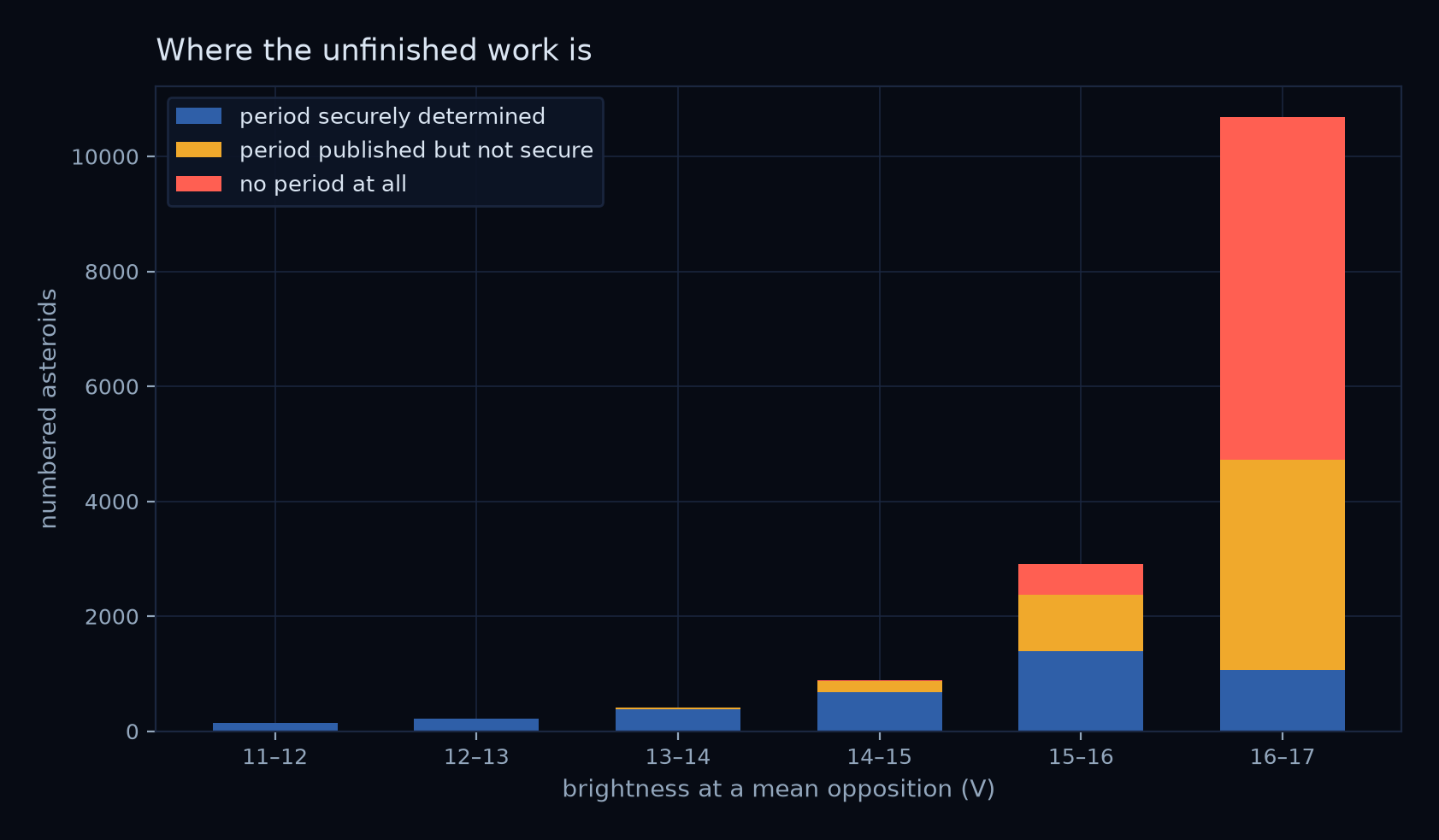
There are 243 asteroids that reach 15th magnitude or brighter at an ordinary opposition and whose published rotation period is not secure. Confirming or correcting one of those is a real result, and it does not require pushing the equipment to its limit.
Citizen science is how most of this got measured
It would be easy to assume that a 60 mm telescope is a teaching toy and the real work happens elsewhere. Asteroid photometry is the clearest counter-example in astronomy. The archive this page draws on, ALCDEF, is built substantially from observations made by individuals at small private observatories, and two of the four curves plotted above are theirs: 90 Antiope by Frederick Pilcher, 1 Ceres by Robert Stephens. Those are not illustrations of what amateurs might contribute. They are the data.
The reason the field stays open to small instruments is that rotation periods need time more than they need aperture. A period of seven hours has to be watched for seven hours, then confirmed on another night, then checked at a different viewing geometry a year later. Large telescopes are oversubscribed and cannot spend nights staring at one 20 km rock. A backyard rig can, and that asymmetry is not going to change.
So the honest framing is not that there is a pile of undiscovered periods waiting for a beginner. Nearly every asteroid a small telescope can reach already has a published curve. The contribution is different, and it is real:
- Independent confirmation. 79% of graded periods are not securely determined. A published number that no one has ever reproduced is a weaker fact than it looks, and reproducing it is a contribution in its own right.
- Monitoring over years. Amplitude changes with viewing geometry, so the same object measured at several apparitions constrains its pole direction and its shape — something no single night can do, at any aperture.
- Newly discovered near-Earth objects. These are genuinely time-critical. A new NEO is bright for days and then gone, its rotation state unknown, and the surveys that found it are busy finding the next one. This is the one place where a small telescope can produce a measurement nobody else has.
- Archiving the photometry, not just the conclusion. Reporting in ALCDEF format means the individual measurements outlive whatever period was fitted from them, and can be refolded when someone has more data.
None of that depends on being first. It depends on being careful, and on turning up repeatedly — which is exactly what an instrument you own, in a field you can reach on a Tuesday, is good for.
Validate first, then contribute
The sequence matters more than the ambition. A pipeline that has never reproduced a known answer cannot be trusted with an unknown one.
1 · Build the moving-target pipeline
Adapt the shared photometry engine to targets that move: predict the asteroid's position at each frame from an ephemeris, place a forced aperture there, and keep it out of the comparison-star ensemble. Everything upstream — calibration, plate solving, the ensemble — already works.
2 · Reproduce known answers
Measure bright asteroids with securely determined periods and check that we recover them, including the double-peaked fold. If the pipeline cannot return a known period, no new period from it means anything.
3 · Work the uncertain list
Move to objects whose published periods are flagged as insecure, and to the fainter end where periods are missing altogether. Report results in ALCDEF format so the photometry itself is archived, not just the conclusion.
Step-two targets
Bright, securely measured, and short enough to catch in a single night — queried live from the database.
| Object | H | V at opposition | Known period |
|---|---|---|---|
| 4 Vesta (A807 FA) | 3.25 | 5.8 | 5.342 h |
| 2 Pallas (A802 FA) | 4.12 | 7.6 | 7.813 h |
| 7 Iris (A847 PA) | 5.70 | 8.3 | 7.139 h |
| 6 Hebe (A847 NA) | 5.62 | 8.3 | 7.274 h |
| 3 Juno (A804 RA) | 5.19 | 8.4 | 7.210 h |
| 15 Eunomia (A851 OA) | 5.42 | 8.6 | 6.083 h |