Crossing Mars but not Earth
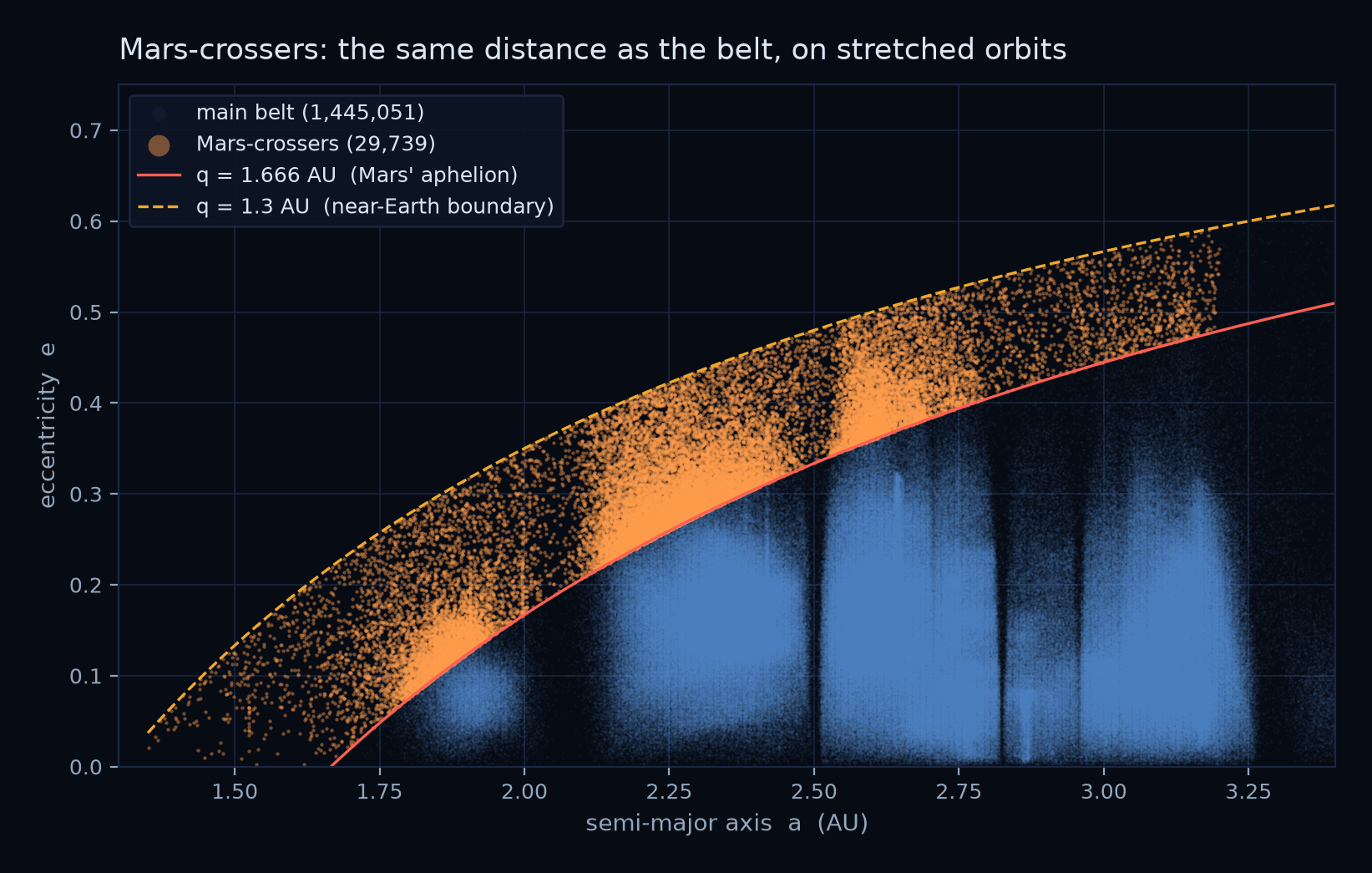
The definition is two numbers. A Mars-crosser's perihelion lies below 1.666 AU, which is as far from the Sun as Mars ever gets, so at some point in its orbit it is inside Mars' path. And it lies above 1.3 AU, the near-Earth boundary, so it never reaches our neighbourhood.
What makes them a distinct population is not where they orbit but how elliptical those orbits are. Their median semi-major axis is 2.26 AU, squarely inside the belt. Their median eccentricity is 0.30, against 0.14 for belt asteroids spanning the same distances. A Mars-crosser is a belt asteroid whose orbit has been stretched.
The staging area
That stretching is the point. Asteroids drift into orbital resonances with Jupiter, which pump up eccentricity while leaving the semi-major axis largely alone. An orbit pumped far enough reaches down to Mars, and the asteroid becomes a Mars-crosser.
From there Mars takes over. Repeated close passes to a planet are an efficient way to change an orbit, and over time they push perihelion further in until the object crosses the 1.3 AU line and is reclassified as near-Earth. This is the main road from the belt into near-Earth space, and it is why the two populations cannot be understood separately.
It also means this population is not primordial. Mars-crossing orbits are unstable on timescales far shorter than the age of the solar system, so the objects here are in transit and are being continuously resupplied from the belt behind them.
Bright for their size
Because they come closer than the belt, Mars-crossers are brighter than a belt asteroid of the same size, which makes them easier targets than their distance from the headlines suggests. The largest, 132 Aethra, is about 43 km across and was found in 1873 — the first Mars-crosser known, decades before anyone understood what the category meant.
Only about 2% have a measured diameter, rotation period or albedo — no better characterised than the main belt, despite being closer and brighter. For a population that feeds the near-Earth objects, that is a conspicuous gap.
Best-known members
Brightest by absolute magnitude, named objects first. Queried live from the catalog.
| Object | H | Diameter | a | e | i | Period |
|---|---|---|---|---|---|---|
| 132 Aethra (A873 LA) | 8.96 | 43 km | 2.61 AU | 0.387 | 25.0° | 4.2 yr |
| 512 Taurinensis (A903 MC) | 10.76 | 23 km | 2.19 AU | 0.254 | 8.8° | 3.2 yr |
| 391 Ingeborg (A894 VB) | 10.85 | 16 km | 2.32 AU | 0.305 | 23.2° | 3.5 yr |
| 1310 Villigera (1932 DB) | 11.46 | — | 2.39 AU | 0.357 | 21.1° | 3.7 yr |
| 699 Hela (A910 LC) | 11.46 | — | 2.62 AU | 0.410 | 15.3° | 4.2 yr |
| 475 Ocllo (A901 PA) | 11.53 | 18 km | 2.59 AU | 0.379 | 18.9° | 4.2 yr |
| 1204 Renzia (1931 TE) | 12.00 | — | 2.26 AU | 0.295 | 1.9° | 3.4 yr |
| 3674 Erbisbuhl (1963 RH) | 12.03 | 9 km | 2.36 AU | 0.376 | 21.0° | 3.6 yr |
The 3-D viewer plots all 1,557,369 catalogued objects at a fixed instant. Each population can be isolated, so this family can be viewed on its own against the planets.