Best-known members
Brightest by absolute magnitude, named objects first. Queried live from the catalog.
| Object | H | Diameter | a | e | i | Period |
|---|---|---|---|---|---|---|
| 1036 Ganymed (A924 UB) | 9.17 | 38 km | 2.66 AU | 0.533 | 26.7° | 4.3 yr |
| 433 Eros (A898 PA) | 10.40 | 17 km | 1.46 AU | 0.223 | 10.8° | 1.8 yr |
| 1866 Sisyphus (1972 XA) | 12.47 | 8 km | 1.89 AU | 0.538 | 41.2° | 2.6 yr |
| 4954 Eric (1990 SQ) | 12.54 | 11 km | 2.00 AU | 0.449 | 17.4° | 2.8 yr |
| 1627 Ivar (1929 SH) | 12.79 | 9 km | 1.86 AU | 0.397 | 8.5° | 2.5 yr |
| 3552 Don Quixote (1983 SA) | 13.02 | 19 km | 4.27 AU | 0.707 | 31.1° | 8.8 yr |
| 2212 Hephaistos (1978 SB) | 13.45 | 6 km | 2.17 AU | 0.835 | 11.2° | 3.2 yr |
| 1980 Tezcatlipoca (1950 LA) | 13.80 | 4 km | 1.71 AU | 0.365 | 26.9° | 2.2 yr |
Four groups, one boundary
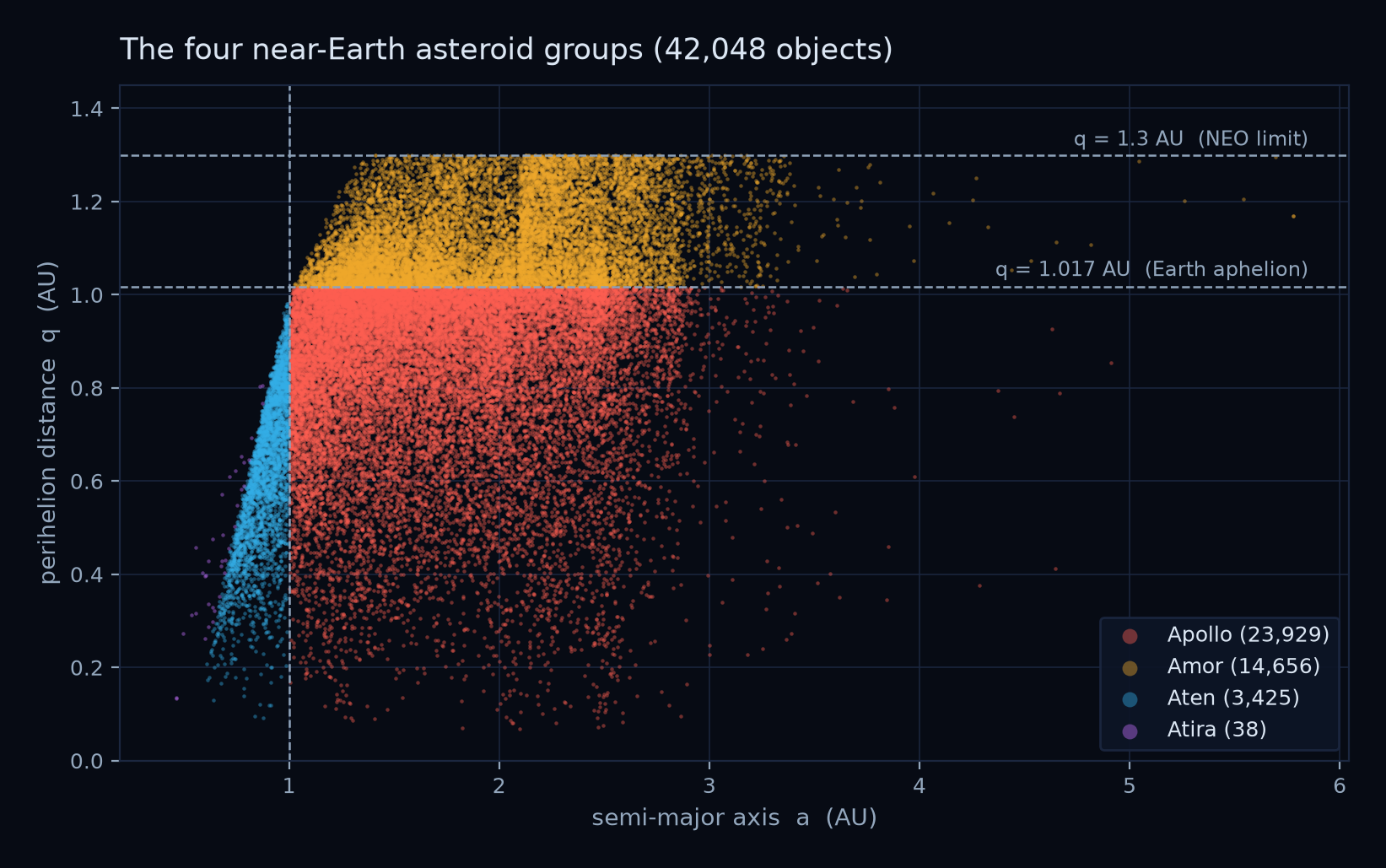
The near-Earth asteroids are split by two numbers: Earth's perihelion at 0.983 AU and its aphelion at 1.017 AU. An asteroid with a semi-major axis above 1 AU and a perihelion below 1.017 AU must cross our orbit — that is an Apollo, and with 23,933 known they are by far the largest of the four groups, which together number 42,062.
Atens cross from the inside, with orbits smaller than Earth's on average. Amors come close but never cross. And Atiras orbit entirely within Earth's orbit — only 38 are known, not because they are rare but because they are almost impossible to find: they never appear far from the Sun in our sky.
Why they exist at all
Near-Earth space is not a stable place to keep an asteroid. Orbits here are cleared out on timescales of a few million years — short compared to the age of the solar system. The population we see is therefore not primordial; it is continuously resupplied.
The source is the main belt. Asteroids drift into orbital resonances with Jupiter, which pump up their eccentricity until they cross Mars, then Earth. The Mars-crossers (29,739 of them) are the staging area of that pipeline, and the Kirkwood gaps are the leaks it drains from.
The hazard question, stated carefully
2,547 objects are formally potentially hazardous: their orbits pass within 0.05 AU of Earth's and they are bright enough (H ≤ 22) to imply a diameter of roughly 140 m or more. "Potentially hazardous" is a statement about orbital geometry and size, not a prediction — it means close enough and large enough to be worth tracking. No known asteroid poses a significant risk of striking Earth this century.
Near-Earth asteroids are the best-observed population in the solar system, so only 129 of them lack the data to be assessed at all. Across all asteroids the picture reverses: 33,437 cannot be assessed either way, because the test needs both a well-determined closest-approach distance and a brightness, and they are missing one or the other.
What a small telescope can add
NEO work is one of the few areas where modest apertures still contribute real data. Newly discovered objects need astrometric follow-up within days or their orbits are lost, and the surveys that find them are busy finding more. Rotation periods are the other gap, and a bigger one: barely two per cent of catalogued small bodies have one, and a period comes from a light curve that a small telescope can measure over a few nights. Near-Earth asteroids are the most accessible population in which to change that.
When Earth briefly has two moons
Every so often an asteroid does not merely pass by — it is captured. Earth's gravity takes hold, the object becomes temporarily bound, and for weeks or years the planet has a second natural satellite. Then the Sun pulls it away again.
Capture requires a coincidence. The object has to arrive on an orbit almost identical to Earth's, and it has to arrive slowly — at a relative speed of metres per second rather than kilometres per second. Look at the elements of the known cases and the pattern is unmistakable: semi-major axis within a few percent of 1 AU, eccentricity under 0.06, inclination under two degrees. These objects were already travelling alongside us.
The reason we know of only a handful is size. A rock one metre across is around 20th magnitude even when it is as close as the Moon, and it fades fast as it recedes — roughly 25th magnitude at ten times the Moon's distance. The magnitude scale runs backwards, and steeply: bigger numbers mean fainter objects, five magnitudes is a factor of a hundred in brightness, and the faintest star the unaided eye can see is about 6th. So 20th magnitude is already some 400,000 times fainter than anything the eye can pick up, and 25th needs a survey telescope. It also crosses the sky quickly while it is near. That combination is why every object on this list was found by a major survey, and why several were noticed only after they had been in orbit for years. Population models suggest Earth has a temporarily captured object of roughly a metre across almost all the time, and that we simply do not see them.
| Object | Bound to Earth | Duration | Revolutions | Diameter | H |
|---|---|---|---|---|---|
| 1991 VG | Dec 1991 – Jan 1992 | a few weeks | under one | ~8 m | 28.3 |
| 2006 RH120 | Jun 2006 – Jul 2007 | about 13 months | about 4 | ~4 m | 29.5 |
| 2020 CD3 | about 2017 – Mar 2020 | roughly 3 years | several | ~2 m | 31.7 |
| 2022 NX1 | brief, in 1981 and again 2022 | weeks | under one | ~8 m | 28.1 |
| 2024 PT5 | 29 Sep – 25 Nov 2024 | about 2 months | under one | ~11 m | 27.4 |
Diameters are estimated from the absolute magnitude recorded for each object, assuming a typical stony reflectivity; for objects this small the real reflectivity is unknown, so treat them as good to a factor of about two. The capture windows come from published orbit calculations — being "captured" is a statement about orbital energy, not something anyone watched happen.
What each one was
- 1991 VG — The first object suspected of temporary capture. Its Earth-like orbit was so improbable that artificial origin was seriously proposed; it is now accepted as natural. Returns periodically.
- 2006 RH120 — The first confirmed temporary satellite. It completed roughly four revolutions of Earth before escaping — genuinely a second moon, for a year.
- 2020 CD3 — The longest confirmed capture, and the smallest object: a boulder. It had been orbiting Earth for years before anyone noticed it.
- 2022 NX1 — A recurring visitor rather than a one-off — it was temporarily captured once before, and is expected back around 2051.
- 2024 PT5 — The one that made recent headlines as Earth's "second moon". Strictly it never completed a revolution: it was bound just long enough to swing past on a horseshoe path before the Sun pulled it away again. NASA's Center for Near-Earth Object Studies has suggested it may be lunar ejecta — a piece of the Moon knocked loose by an impact, rather than an asteroid from elsewhere.
2020 SO was captured from Nov 2020 – Mar 2021 — about 4 months as a second moon — and was given a minor-planet designation before anyone worked out what it was. Its orbit was too Earth-like, and its acceleration under sunlight implied something with a very high area-to-mass ratio: a hollow shell rather than a rock. It turned out to be the Centaur upper stage from the 1966 Surveyor 2 launch, returning after 54 years.
You can verify the consequence here: 2020 SO is absent from this catalog, because once identified as a spacecraft it stopped being a small body.
Not every "second moon" is a capture
This is the most confused point in the popular coverage. In 2024 the headlines were about 2024 PT5, which really was briefly bound to Earth — it is in the table above. In 2025 the headlines said much the same thing about 2025 PN7, and that object was never captured at all.
2025 PN7 is a quasi-satellite: an asteroid orbiting the Sun, not the Earth, but doing it in step with us. It sits in a 1:1 resonance, taking one year to go round, so it never falls behind and never gets ahead. Seen from a frame that turns with the Earth, that produces a slow loop around our planet which looks exactly like an orbit — and is not one. Earth's gravity shapes the path; it does not hold the object. Cut the Sun out of the picture and a quasi-satellite simply drifts away, because there was never a bound orbit to begin with.
The distinction shows up in the orbital elements. In the period column below, the quasi-satellites are locked at essentially one year exactly and the genuinely captured 2024 PT5 is not. Because its period differs, 2024 PT5 drifts relative to Earth and could only ever be a visitor. The quasi-satellites, paradoxically, keep us company for decades to centuries — far longer than any real capture — precisely because they were never captured.
| Object | Semi-major axis | Period | Diameter | What it is |
|---|---|---|---|---|
| 469219 Kamoʻoalewa | 1.0010 AU | 1.000 yr | ~47 m | quasi-satellite |
| 2025 PN7 | 1.0010 AU | 1.000 yr | ~18 m | quasi-satellite |
| 2023 FW13 | 0.9990 AU | 0.998 yr | ~21 m | quasi-satellite |
| 2014 OL339 | 0.9986 AU | 0.998 yr | ~95 m | quasi-satellite |
| 2024 PT5 | 1.0220 AU | 1.030 yr | ~11 m | genuinely captured, for two months |
Elements from this release; diameters estimated from absolute magnitude at a typical stony reflectivity, so treat them as good to a factor of about two. The notes on each object come from the published literature, not from the catalog.
Three terms are worth keeping straight, because the headlines blur all of them together. A temporarily captured orbiter is genuinely bound and completes at least one revolution — 2006 RH120 is the clean example. A temporarily captured flyby is bound only briefly and never gets round even once, which is what 2024 PT5 did. A quasi-satellite is never bound at all. Only the first two are moons in any sense, and only the first is unambiguously one.
One more thread ties these together. 469219 Kamoʻoalewa is thought to be a fragment of the Moon, blasted off by an impact and now pacing the Earth–Moon system, and the same origin has been proposed for 2024 PT5. If that holds, some of these companions are not captured asteroids in any sense: they are pieces of our own Moon that never quite left.
Capture is easier to feel than to read about. The NEO Capture Lab is an interactive three-body model of the Earth–Moon system with solar tidal forcing: set an asteroid's approach speed and geometry and watch whether it is captured, how many revolutions it manages, and how it escapes. Most attempts fail, which is the lesson.
It runs in the browser and models the dynamics in scaled units — it is a teaching instrument, not a precision integrator. It will not reproduce a specific object's trajectory, but it does demonstrate how complex the resulting orbits can be.
The 3-D viewer plots all 1,557,369 catalogued objects at a fixed instant. Each population can be isolated, so this family can be viewed on its own against the planets.