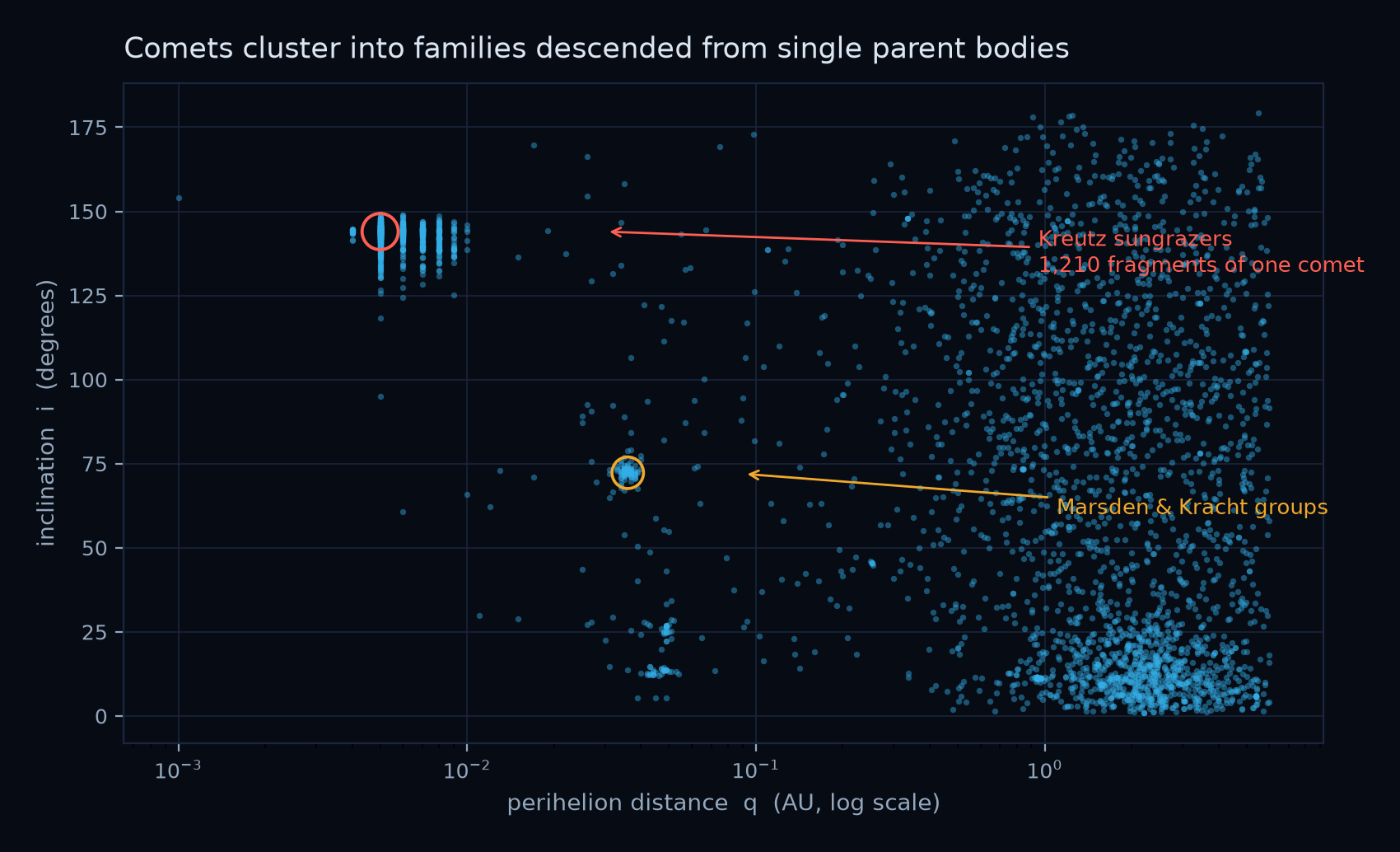
One comet, a thousand pieces
Every Kreutz member has essentially the same orbit: perihelion about 0.005 AU and inclination near 144°. 1,210 of them are catalogued. That is not a coincidence of dynamics; it is a genealogy. They are fragments of a single progenitor comet that broke up, whose pieces continued to break up on subsequent passes.
The bright historical members were spectacular. The Great March Comet of 1843 was visible in daylight; the Great Southern Comets of 1880 and 1887 followed, along with C/1963 R1 Pereyra and others. All are the same object, seen in pieces across centuries.
Why we suddenly know about so many
Most Kreutz members were never seen from the ground. They were found by the SOHO spacecraft's coronagraph, which blocks the Sun's disk and watches the corona continuously — exactly where a sungrazer appears in its final hours. Several thousand have been spotted this way, most of them metres to tens of metres across and evaporating completely at perihelion. Only a fraction are ever tracked well enough to receive a designation and enter a catalog like this one, which is why the number here is smaller than the number discovered.
This is a selection effect worth stating plainly: the comet population in any catalog is dominated not by independent comets but by one disintegrated progenitor observed by one instrument. Quote comet statistics without that caveat and they mislead.
Other families
The Marsden and Kracht groups form a second, smaller stream at inclination about 72°, related to the comet 96P/Machholz. And 73 catalogued fragments of 73P/Schwassmann-Wachmann 3 orbit between 1 and 5 AU — a break-up we watched happen rather than inferred.
Fragment families are how we get to see the inside of a comet. The nucleus is normally hidden by its own coma; disruption exposes fresh interior material and reveals how weakly these bodies are held together.
The Kreutz progenitor's size, and when exactly it broke up, are both estimates. Whether the stream is still producing large fragments is an open question with obvious observational appeal.
The 3-D viewer plots all 1,557,369 catalogued objects at a fixed instant. Each population can be isolated, so this family can be viewed on its own against the planets.