Standing still in a rotating frame
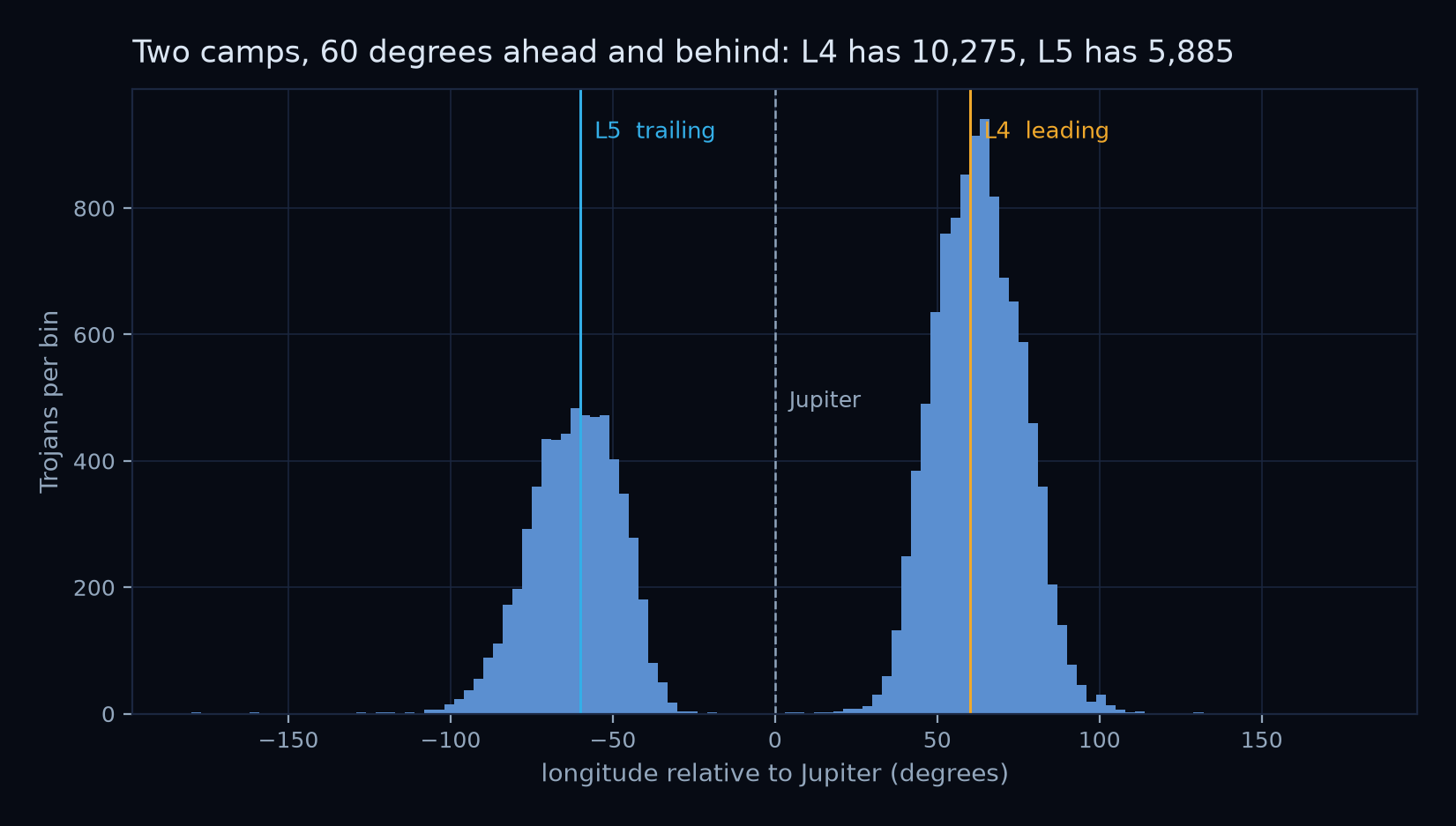
Two bodies orbiting each other create five positions where the pull of both and the swing of the orbit cancel out, so a third, much smaller body can keep station. These are the Lagrange points, and only two of the five are genuinely stable: L4 and L5, 60 degrees ahead of and behind the planet. Nudge an object away from those and it drifts back, tracing a slow loop that can persist for the age of the solar system, whereas at the other three a nudge grows instead of fading, which is why nothing accumulates there. Jupiter's two camps are the most populous known: the leading one is traditionally named for Greek heroes and the trailing one for Trojans, which is where the population's name comes from.
The two camps are not equal, and nobody fully explains why. The catalog holds about 1.75 times as many objects in L4 as in L5, and while some of that is observational, the excess appears to survive correction for how each camp was surveyed. A real asymmetry would be a fossil of how the outer planets migrated early on. It remains an open question.
Probably not local
Trojans are dark and red — spectrally more like cometary nuclei and Kuiper Belt objects than like main-belt asteroids. The leading explanation is that they did not form at 5.2 AU at all: as the giant planets shifted position, objects scattered inward from beyond Neptune were captured into the camps.
That makes them unusually valuable. Material from the outer solar system, held at a distance a spacecraft can reach, which is precisely why NASA's Lucy mission is visiting several.
They are also reachable from the ground. At 5.2 AU Trojans are faint — typically magnitude 15 to 18 — but they move slowly, which makes them forgiving targets for long exposures. Rotation periods and light-curve amplitudes remain sparse for the population, and amplitude distributions carry information about shapes and binarity.
Only a small fraction of Trojans have measured rotation periods, and the L4/L5 asymmetry is still unexplained.
Best-known members
Brightest by absolute magnitude, named objects first. Queried live from the catalog.
| Object | H | Diameter | a | e | i | Period |
|---|---|---|---|---|---|---|
| 624 Hektor (A907 CF) | 7.32 | 225 km | 5.28 AU | 0.024 | 18.1° | 12.1 yr |
| 911 Agamemnon (A919 FB) | 7.87 | 131 km | 5.29 AU | 0.067 | 21.8° | 12.2 yr |
| 1437 Diomedes (1937 PB) | 8.14 | 118 km | 5.23 AU | 0.046 | 20.4° | 12.0 yr |
| 588 Achilles (A906 DN) | 8.20 | 130 km | 5.22 AU | 0.148 | 10.3° | 11.9 yr |
| 1172 Aneas (1930 UA) | 8.21 | 118 km | 5.24 AU | 0.105 | 16.6° | 12.0 yr |
| 617 Patroclus (A906 UL) | 8.22 | 140 km | 5.21 AU | 0.139 | 22.1° | 11.9 yr |
| 1867 Deiphobus (1971 EA) | 8.32 | 118 km | 5.14 AU | 0.044 | 26.9° | 11.6 yr |
| 1143 Odysseus (1930 BH) | 8.38 | 115 km | 5.23 AU | 0.090 | 3.1° | 12.0 yr |
The 3-D viewer plots all 1,557,369 catalogued objects at a fixed instant. Each population can be isolated, so this family can be viewed on its own against the planets.