A population defined by impermanence
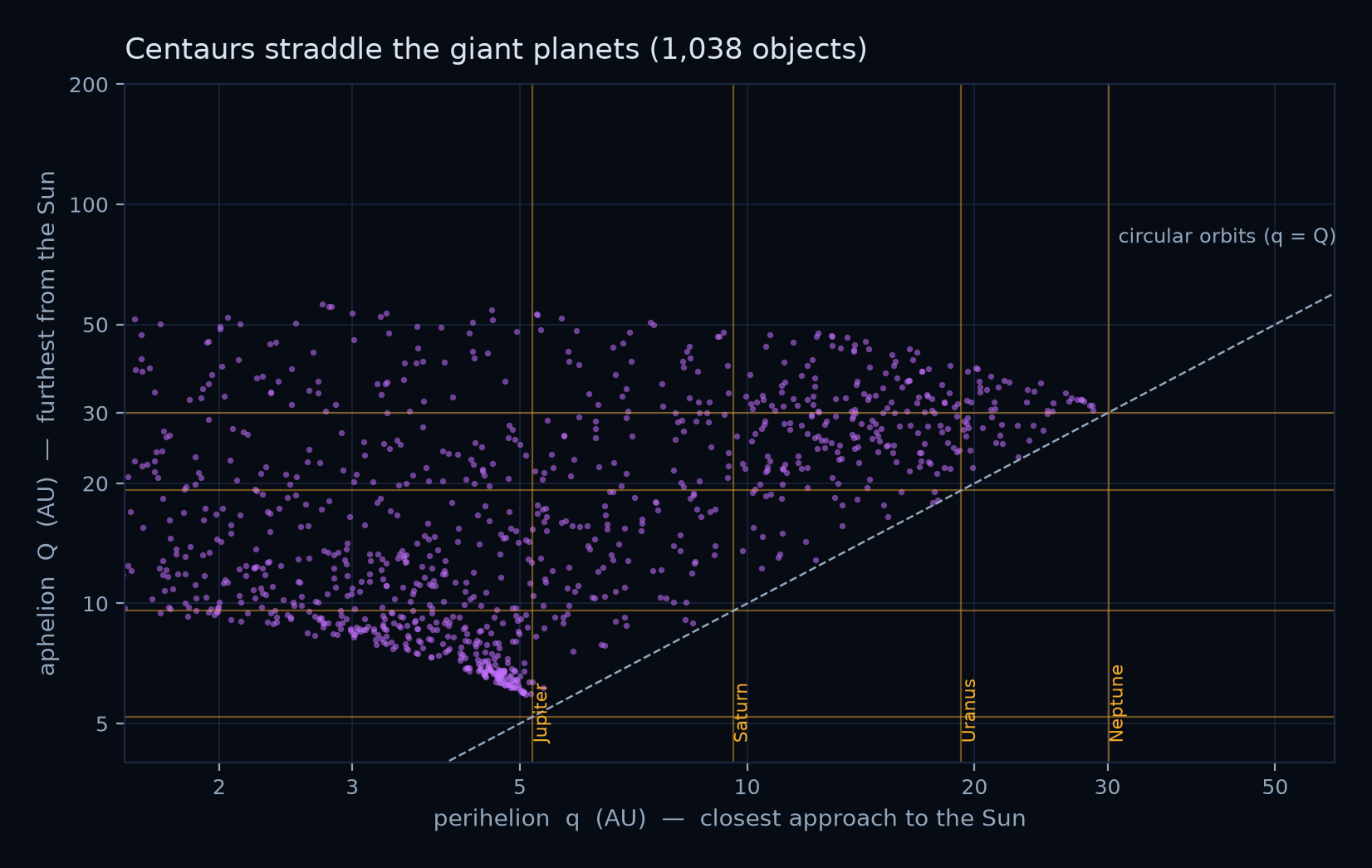
A Centaur's orbit crosses those of one or more giant planets, so close encounters are inevitable. Typical dynamical lifetimes are a few million years, ending in ejection from the solar system, a collision, or capture into the inner system as a Jupiter-family comet.
Like the near-Earth asteroids, then, this is a transient population that must be resupplied — in this case from the Kuiper Belt. Centaurs are the middle of a conveyor belt running from beyond Neptune to the inner solar system.
Asteroid or comet?
The category dissolves on inspection. 2060 Chiron was discovered in 1977 and catalogued as an asteroid; years later it developed a coma and received a cometary designation as well. It now holds both. Several Centaurs show intermittent activity far from the Sun, where water ice is too cold to sublimate — more volatile ices, or crystallising amorphous ice, are the likely drivers.
Our schema inherits this ambiguity honestly rather than resolving it: an object's dynamical class and its activity are separate facts, and the schema records the classification the source asserts rather than forcing a choice.
Rings where nobody expected them
In 2013, occultation observations of the Centaur 10199 Chariklo revealed two narrow rings — the first found around anything other than a giant planet. Ring systems around small bodies now appear to be a real phenomenon rather than a curiosity.
That result came from stellar occultations: watching a star blink out as the object passes in front. It needs precise timing rather than a large aperture, which makes it one of the genuinely open frontiers for coordinated small-telescope work.
With only about a thousand known and lifetimes of a few million years, the Centaur population's size and resupply rate are still poorly constrained.
Best-known members
Brightest by absolute magnitude, named objects first. Queried live from the catalog.
| Object | H | Diameter | a | e | i | Period |
|---|---|---|---|---|---|---|
| 2060 Chiron (1977 UB) | 5.54 | 166 km | 13.68 AU | 0.380 | 6.9° | 50.6 yr |
| 10199 Chariklo (1997 CU26) | 6.55 | 302 km | 15.73 AU | 0.171 | 23.4° | 62.4 yr |
| 5145 Pholus (1992 AD) | 7.07 | 190 km | 20.29 AU | 0.575 | 24.8° | 91.4 yr |
| 463368 Eurytus (2012 VU85) | 7.32 | — | 29.47 AU | 0.315 | 15.1° | 160.0 yr |
| 54598 Bienor (2000 QC243) | 7.49 | 188 km | 16.60 AU | 0.206 | 20.7° | 67.7 yr |
| 55576 Amycus (2002 GB10) | 7.56 | 101 km | 24.94 AU | 0.393 | 13.4° | 125.0 yr |
| 10370 Hylonome (1995 DW2) | 8.20 | — | 24.95 AU | 0.247 | 4.1° | 125.0 yr |
| 121725 Aphidas (1999 XX143) | 8.88 | — | 17.96 AU | 0.461 | 6.8° | 76.1 yr |
The 3-D viewer plots all 1,557,369 catalogued objects at a fixed instant. Each population can be isolated, so this family can be viewed on its own against the planets.