Three populations in one
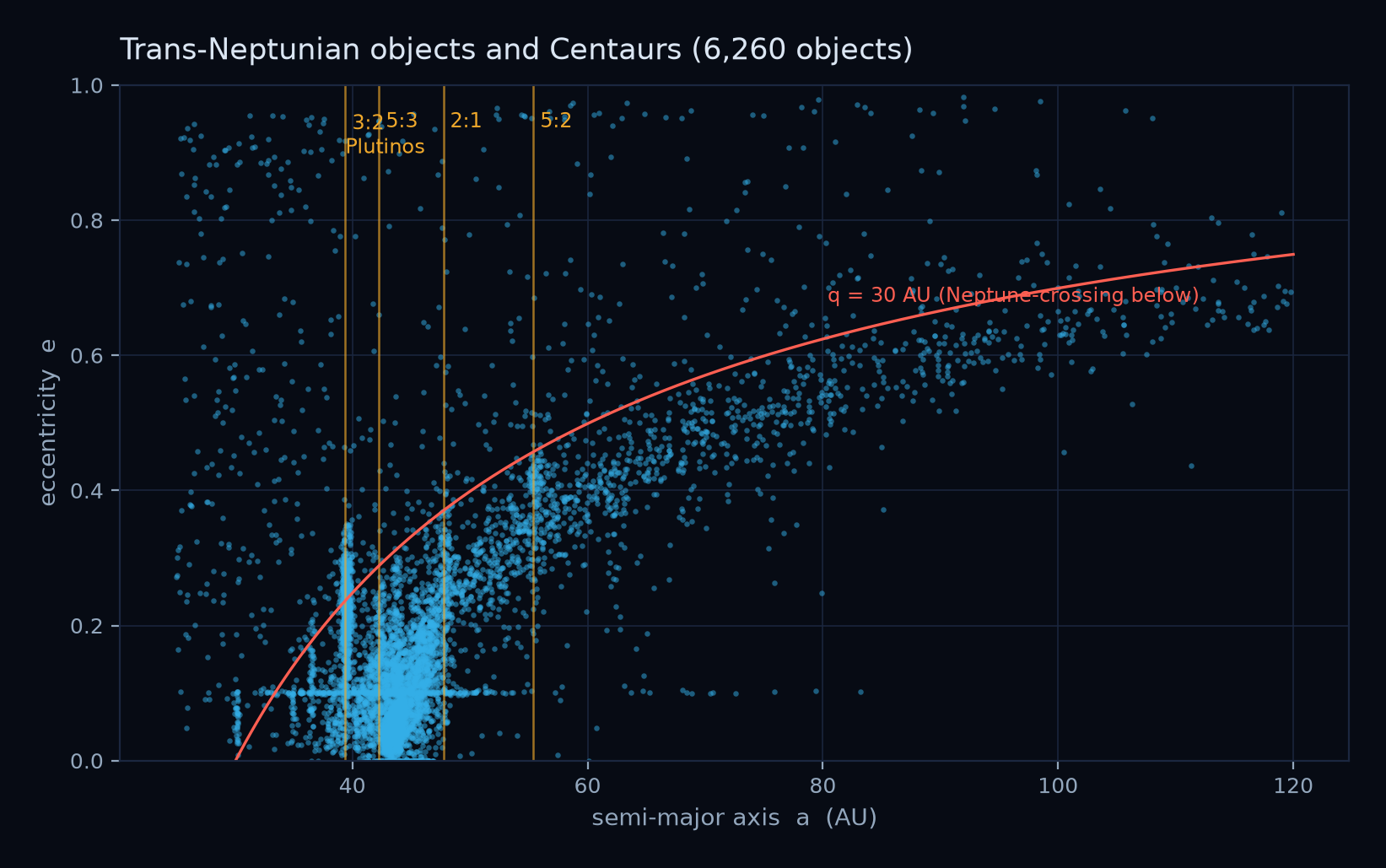
The classical belt sits between about 42 and 48 AU on nearly circular orbits, undisturbed since formation. The resonant objects are locked to Neptune in simple period ratios, the 3:2 Plutinos being the largest group. The scattered disk is on eccentric, inclined orbits reaching far out, having been flung there by encounters with Neptune.
Which population an object belongs to is a statement about history, and separating them requires long observational arcs. Many catalogued TNOs still have orbits too uncertain to classify.
Taken together the three make a record of planetary migration. The resonant populations are the strongest evidence that Neptune did not form where it now orbits: as it migrated outward it swept resonances through the disk, capturing objects as it went, so the number and distribution of Plutinos is a constraint on how far and how fast Neptune moved — a dynamical fossil.

Extremely hard to observe
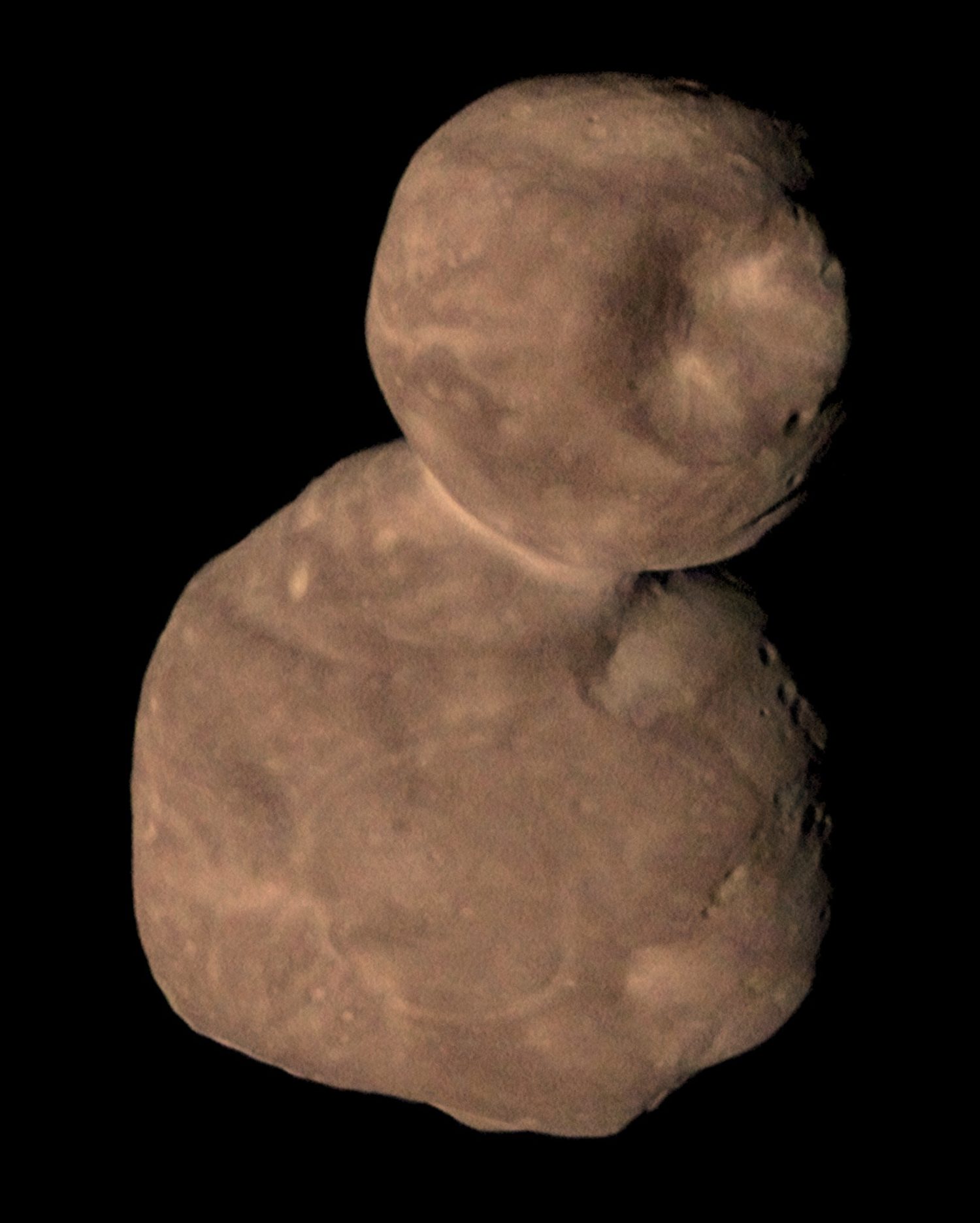
A 100 km object at 45 AU sits near 25th magnitude — millions of times fainter than anything the eye can see. TNOs are faint, slow, and small on the sky, and rotation periods require photometry at the limit of large telescopes.
The exception is occultations. When a TNO passes in front of a star, the shadow it casts is a direct measurement of its size and shape, and the observation is about timing precision rather than aperture. Occultation campaigns are coordinated across many small telescopes because the shadow track is narrow and poorly predicted — and every extra station helps.
The known trans-Neptunian objects are a small sample of a population thought to exceed 100,000 bodies above 100 km. Sizes exist for very few, and nearly all of those came from thermal infrared measurements, a stellar occultation, or a spacecraft visit — which is why the diameter column below is almost empty even for the largest objects known.
Best-known members
Brightest by absolute magnitude, named objects first. Queried live from the catalog.
| Object | H | Diameter | a | e | i | Period |
|---|---|---|---|---|---|---|
| 136199 Eris (2003 UB313) | -1.26 | — | 67.93 AU | 0.438 | 43.9° | 560.0 yr |
| 134340 Pluto (1930 BM) | -0.55 | — | 39.59 AU | 0.252 | 17.1° | 249.0 yr |
| 136472 Makemake (2005 FY9) | -0.25 | — | 45.57 AU | 0.159 | 29.0° | 308.0 yr |
| 136108 Haumea (2003 EL61) | 0.14 | — | 43.06 AU | 0.194 | 28.2° | 283.0 yr |
| 90377 Sedna (2003 VB12) | 1.50 | — | 543.70 AU | 0.860 | 11.9° | 12,700.0 yr |
| 225088 Gonggong (2007 OR10) | 1.82 | — | 66.87 AU | 0.504 | 30.9° | 547.0 yr |
| 90482 Orcus (2004 DW) | 2.13 | — | 39.38 AU | 0.221 | 20.6° | 247.0 yr |
| 50000 Quaoar (2002 LM60) | 2.41 | — | 43.16 AU | 0.035 | 8.0° | 284.0 yr |
The 3-D viewer plots all 1,557,369 catalogued objects at a fixed instant. Each population can be isolated, so this family can be viewed on its own against the planets.